
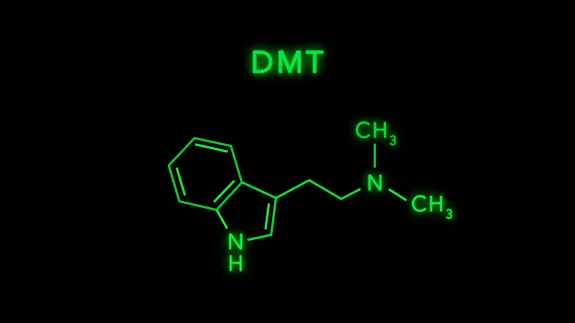
A new 2025 review has examined the endogenous role of DMT, calling for further research into the molecule “as a potential neurotransmitter”.
DMT is found in plants, animals, and human beings. Used for thousands of years as an ingredient in the psychedelic concoction ayahuasca, DMT is often sourced from trees such as Banisteriopsis caapi and Mimosa tenuiflora.
One researcher, Rick Strassman, Clinical Associate Professor of Psychiatry at the University of New Mexico School of Medicine, theorises in his book DMT: The Spirit Molecule that this hallucinogenic compound is released from the pineal gland in large quantities at crucial moments of the human experience – when we’re born, when we dream, and when we die.
The theory suggests that these surges of DMT can elicit hallucinations, mystical, and near-death experiences – but is this true?
Measuring Endogenous DMT: Blood markers and Brains
While research shows that trace amounts of DMT can be found in the human brain, the jury is still out on the endogenous role of DMT.
Some research suggests that these very small traces of the compound are not enough to create hallucinations, while other research suggests that the release of endogenous DMT, for example, under physiological stress, may contribute to hallucinations.
The researchers suggest that investigating exogenous DMT may contribute to our understanding of conditions such as psychoses, sleep disorders, or autism, near-death experiences, and endogenously produced altered states.
Chris Timmermann of Imperial College London at the Centre for Psychedelic Research leads the DMT Research Group, where he has been studying the brain mechanisms of psychedelics using fMRI and M/EEG, with a special focus on DMT.
Timmermann says that one of the biggest obstacles in understanding the role of endogenous DMT in the body is in detecting it.
There is no way of directly measuring DMT, and our current detection of it relies on imaging techniques such as EEG and fMRI.
“I think that the biggest challenge is how we accurately detect it,” says Timmermann.
“There's some technical difficulties there, and some labs are developing interesting methods to do this. Then there is also the methodological issue of capturing it at the right time.
“So, if DMT is involved in dreaming, for example, we need to have a marker of REM sleep, and then take blood out, and then do the assays. It's not that easy.”
Timmermann, who also studies the impact of meditation on the brain, notes that these challenges are the same as with intense meditative experiences.
While previous studies have found DMT in rat pineal glands, Timmermann highlights that science has since discredited that the pineal gland is necessary for the production of DMT and that DMT can be produced elsewhere in the brain
“We've also mapped out very little of the margins of the mind and what's happening beyond our usual experiences, and there's a wide variety in them,” says Timmermann.
“It's not a straightforward thing as they're not all the same.
“As we develop literacy around these different non-ordinary states of consciousness, we can refine our understanding of the roles that different neurotransmitters and some molecules’ mechanisms have."
Developing these biomarkers and ways of more accurately measuring DMT may help us understand where and in what amount it can be found in the brain, but it does not provide insight into its function.
DMT as a Neurotransmitter
While exogenous DMT is currently being researched for therapeutic applications such as anxiety and severe depression, as well as in neurodegenerative conditions such as Alzheimer’s Disease, further research is vital for understanding the true function of endogenous DMT.
The most recent review of research on the topic has looked at its role beyond psychedelic properties, aiming to understand the compound’s biological and physiological functions and provide a closer look at DMT’s therapeutic potential.
Highlighting the common finding that endogenous DMT is found in other regions of the brain beyond the pineal gland, the review found that neurons have the ability to make DMT.
The review shows that in recent studies, the compound has been found to be in the brain continuously, similarly to neurotransmitters such as dopamine and serotonin, potentially playing a role in neuromodulation, neuroprotection and regulating inflammation rather than playing a psychedelic role.
They write: “DMT shows remarkable neurochemical complexity, by its engagement with serotonergic, adrenergic, and σ1 receptors, along with its role in neuroplasticity and potential neuromodulatory and neuroprotective functions.
“This is evident as a possible endogenous neurotransmitter and as a therapeutic tool. Of particular note is DMT's interaction with the σ1R, suggesting its role in cellular homeostasis and stress response.”
They suggest that this function of DMT may offer protection against cellular and tissue damage – “emphasizing its therapeutic potential.”
Adding to this, the authors further highlight how studies show increased endogenous DMT production in high physiological stress situations, such as people climbing at high altitude, further implicating its role as a neuroprotectant.
Low oxygen environments that can create conditions such as hypoxia can reduce MAO activity in the brain – a chemical that breaks down compounds such as DMT – which may allow DMT to accumulate in the brain. However, currently, this idea has not been proven in humans.
These environments are known to cause mild hallucinations or dream-like states.
While the authors highlight that it is not proven, they theorise this could be why low oxygen environments cause altered states of perception; they suggest it could play a role, however, there is no direct evidence and no human studies.
Despite this, the review shows that the role of endogenous DMT in producing hallucinations, dreams, near-death experiences, or being produced during death is unproven, and much more research is needed before we can know whether DMT has a function in producing these altered states.
Stephanie is one of our bloggers here at Psychedelics Community. If you’re interested in joining our blogging team and getting paid to write about subjects you’re passionate about, please reach out to Sam via email at [email protected]