The Fragmented Self: On Psychedelics, Trauma, and Alienation

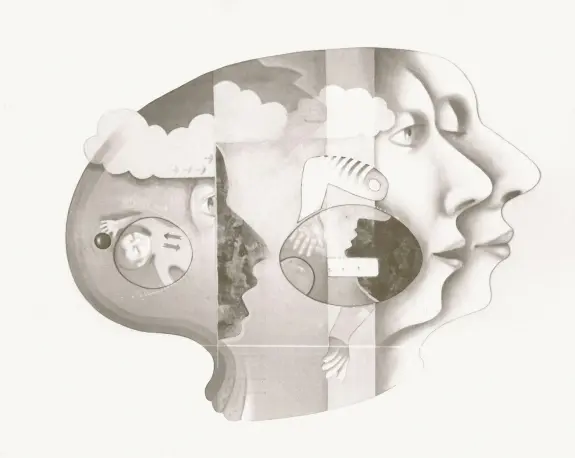
Depending on whom we spend our time with, we can behave so differently that any blinded review of the relevant transcripts would have an onlooker convinced we were different people. We have a ‘work self’, who prides themselves on focus and determined belief in the power of marketing. We hold to a ‘home self’ and a ‘family self’, perhaps more of a gentle provider type, as well as a ‘friend self’, more likely to express obscenity and order a fourth pint without compunction. It feels like an underlying ‘I’ holds them all together. Or does it?
Consider ‘highway hypnosis’. The driver is surrounded by peril. Any wrong-footed gear change, an adventurous shift in lane position, could entail certain death. Yet the driver is amazingly placid – a not-quite-calm, where her alertness is so high that decisions are made as if by another person.
Or reading a book. An imaginative scene will place the reader in a netherworld, one of ‘seeing’ the events in one’s mind’s eye beyond the body. We might be jolted awake by the alarm and lie there for ten minutes: part of us wants to get up, another doesn’t, until something simply happens. We may get angry with our housemates for leaving a pile of dirty plates on the kitchen counter – so angry that we “don’t know what came over us”.
“But at the very instant that the mouthful of tea mixed with cake crumbs touched my palate, I quivered, attentive to the extraordinary thing happening inside me…”, Marcel Proust wrote. A taste of madeleine cake had acquainted his character with a vast reserve of preconscious childhood memory, now there: time travel, or the bud and germination of a seed that was his real being.
That the ‘spotlight self’ of conscious awareness does not reign supreme has been known since antiquity. St. Paul, in his Epistle to the Romans, writes of the “self of flesh” and the “self of spirit”, warring together in his body for the mind’s command. “For that which I do I allow not: for what I would, that do I not; but what I hate, that do I”, he wrote. On the night of his conversion, St. Augustine was reduced to a “fever of irresoluteness”. He beat himself, tore his hair, but according to motions he did not clearly control: “So many things then I did, when ‘to will’ was not in itself ‘to be able’”, he says in Confessions.
Indeed, it is this same disillusionment of the ‘I’ that has attracted attention in psychedelic literature. ‘Ego dissolution’ describes a wilting away of the boundaries of self, leading trippers to cosmic union or an encounter with the void. Ego dissolution is measured with a dedicated inventory, whose scores may predict the degree of relief from depression. Ego loss has also been linked with decoherence in the Default Mode Network, a hypothesised assembly point located across the frontal, parietal, and temporal lobes that creates the ‘resting’ sense of self. As some have pointed out, however, a rudimentary subjective sense remains amid the most awesome self-annihilations: there is a to whom and for whom the event occurs, one capable of memory, interpretation, recall, and later application. Is the ‘I’ dissolved, or is it split into a sort of double?This may prompt a different line of inquiry: what if the self does not ‘come back together again’, but remains diffused across competing models? What if the formerly singular self is left pluralised? What if the self is fractured?
Such phenomena were gathered by French theorists like Pierre Janet in the 19th century. Under conditions of extreme stress, Janet documented, the self would splinter into different competing streams. The “mental energy” available for synthesis was over-spent, creating hallucinations, somnambulism, acts of compulsion, and whole new identities. Are the mentally well so different? William James treated “double consciousness” as evidence that multiple different conscious streams are always in motion, and variously cohered into an ‘I’.
As a student at Harvard, W.E.B. Du Bois studied with James and used ‘double consciousness’ to name the fracture with which black Americans saw themselves at ‘one remove’, estranged to the white gaze. These developments later influenced psychoanalysis: spaltung, or ‘splitting’, is now in common parlance, particularly related to Borderline Personality Disorder, or BPD, for whom psychedelic drugs may pose particular risks. R.D. Laing’s The Divided Self (1960) revolutionised perceptions of psychosis, recasting schizophrenics as creatures caught between a “real self” and a “false self” performed for their families. Eventually, the tension between the two threatens the person’s real existence, bursting forth into psychosis.
The Fragmented Self of Trauma
The most direct analogue to a fragmented self is that of dissociative identity disorder (DID), formerly known as ‘multiple personality disorder’. DID involves two or more identity states, sometimes known as ‘alters’ or a ‘family’, occupying a psychiatric subject. These alters may speak with different accents and respond to alternate names, having different life stories and being totally unaware of the others’ existence. In one case, a 55-year-old woman possessed as many as seven different identity states, including a genial “host” who did not recall her hostile male alter’s episodes of binge drinking. DID is linked to severe childhood trauma, particularly abuse between the ages of six and nine. Psychedelics may lower the dissociative barriers for those with DID. Commenters in the DID Reddit community report being able to “see all of my parts next to me”, everyone “awake and hanging out,” with easier internal conversation and the ability to “pass the controller” between alters more deliberately. LSD is described as “the grease my system didn’t know we needed”. A previously unknown part with homicidal inclinations emerged for one while on LSD.
For some, trips temporarily reduced “automatic switching” and moved responses to a “manual” register, one under their conscious control. Another found the opposite: psilocybin mushrooms “wake everyone up and blend us together a bit into sort of a boiling soup… plus kind of uncontrollable rapid switching at points.” Another describes a 10‑hour “terrible episode of rapid switching and a meltdown” after mushroom tea. So psychedelics can both illuminate and amplify parts‑dynamics, sometimes beyond what the system can stably hold.
The effect of trauma on fracturing the self may be understood through structural dissociation theory. This model distinguishes two psychic parts: the Apparently Normal Part (ANP), the everyday self we take to work, and the Emotional Parts (EP) that carry traumatic wounds. Unlike other disorders, in which the Emotional Parts may flood the ANP with morose ruminations or irrational, constant worry, severe dissociative conditions exhibit a total phobic partition between the two. The reality of suffering severe abuse, for instance, is too terrible for the ANP to admit, unloading the burden on fictional alternate personas that express the traumatic imprint.
The hypothesis of Psychedelic Iatrogenic Structural Dissociation (PISD) seeks to explain cases of traumatic overwhelm in psychedelic sessions. By relaxing the egoic boundary, the subject is then flooded with unregulated Emotional Parts, exacerbating dissociation and perhaps the proliferation of alters. Related phenomena have occurred in psychedelic trial settings. An investigation of psilocybin to treat anorexia nervosa found that numerous participants ‘left their bodies’, observing themselves at one remove, for the purported recovery of previously dissociated memories of sexual abuse. The self may further fragment from that dissociative split at the challenge of reconciling and knitting these ideas into a new narrative self.
Part of the maintenance of the ‘I’ is the ability to shift adjacent models of communication with the context. The REBUS Model of Robin Carhart-Harris, for instance, predicts that psychedelic drugs may relax the high-level priors that structure experience into sensible packets. These may include social interactions, including what norms to follow (and whether they’re real), what words and sentences may be used, and what they mean.
That psychedelic experiences may induce social alienation is widely observed. Social norms and practices may seem plastic and alien; without a new social grammar to ‘step into’, and obliged to continue participating, one is simply fragmented. One questionnaire study among respondents with histories of post-psychedelic problems found that over half had struggled with social connection after their precipitating trips. One respondent clung to workplace routine as the only remaining outer structure after ayahuasca dismantled his sense of self. Another participant moved from a secular Jewish identity to Wicca priestess after a trip left no shared frame for family conversation.
How might fragmentation help us understand depersonalisation/derealisation, or ‘excess openness’?
DP/DR involves a selective impairment of self-awareness. We tend to view it as a condition of attenuation, with the self retreating behind a pane of glass or hazy like a ghost. Looked at differently, though, we may interpret the depersonalised subject as fragmented: the ‘reality sense’ that ordinarily helps to distinguish the true and the false, the real and the dreamlike, has been skewed, blurring into the everyday. The depersonalised subject observes himself ‘from the outside’: this consists in the simultaneous presence of two competing selves, the observer and the actor.
Early studies by Savage and by Silverstein and Klee found that LSD allowed the subjects to watch themselves from above, hanging from the ceiling. Pete Townshend of the Who consumed Serenity, Tranquility, Peace, or STP, on his flight back from the Monterey Pop Festival and “left his body”, gliding around the aisles and fuselage with such drama that Townshend became convinced that consciousness was immaterial.
It is likewise part of common parlance that psychedelics may render one ‘too open’, including to strangers, others in a shared ceremony space, or to ideas, perhaps of a conspiritual variety. The fragmented person may express this openness in a tendency to switch their models on a rapid basis or without remainder, lacking a stable centre from which to evaluate the merits and demerits of each position.
Producing the Psychedelic Self
We can also understand the fragmented self in sociological terms. However “dissolved” one’s self may have been, one is deploying a certain category of self in the self-same process. The French theorist Michel Foucault studied how social orders held on to power through “subjectification.” This term conveys a double meaning: the production of new kinds of people who are, by the very nature of their individuality, subject to others. Enter the “psychedelic self”: a subspecies of the psychological Romantic individual. This self is produced through “the psychedelic experience,” a projective fantasy furnished with ideas from film, books, and music. The self is told the experience will be initiatory and extraordinary, and these hopes are consequently inscribed in the explicit commitment of “intentions,” coupled with preambular integration sessions.
The psychedelic self may even expect the substance itself – either in molecular form, as Dr. Timothy Leary believed, or as a “spirit” – to dispatch explicit guidance. This personhood is further inscribed through the authoring of trip reports and “integration” sessions, specifically designed to manufacture a “new me”. This identity eventually manifests in the material world through aesthetic markers: matted dreadlocks, man-buns, hoodies displaying fungal iconography, or yoga pants inscribed with Om symbols. The psychedelic self begins to speak with idiosyncratic scripts insoluble to outsiders. They inhabit a world of “holding space,” “ceremony,” and “containers.” They discuss “plant medicine,” “shadow work,” “trauma release,” and “downloads.” The self reinforces this personhood through curated playlists, using music to reignite the feelings of the “trip,” and by “finding the others” at workshops stocked with like-minded persons.
Digital surveillance provides the medium for knitting the new self together. Data brokers nudge the self into subreddits and online communities, punctuated by advertisements for BetterHelp, Breaking Convention, or Buddhafield.
The self is thus a social fact existing on two levels.
First, the level of subjectivity. This may be laudable. If one takes drugs to conquer suicidal ideation, this “scripted” self is preferable to no self at all.
Second, the level of social organisation. In a commodity society, the psychedelic self stands as a consumer segment chock full of marketable goods. The predictability of their pathway – from preparation to integration – reflects a rational bundle that meets the needs of producers, marketers, and, increasingly, lobbyists.
“[T]his fragmentation of the object of production necessarily entails the fragmentation of its subject”, Lukacs writes. This process is a social fact, which may be variously perceived and felt by any subject. The fragmentation occurs first through rationalisation. Within the market economy, objects are produced for profit, not for use or need. These are “commodities.” The exchange system compresses wildly different goods – an hour of your time, an apple, a building, a tab of LSD – into a single numerical continuum: the price system. Over time, efficient production favours a homogeneous commodity. The result is the “progressive elimination of the individual attributes of the worker… reduced to a mechanical repetition.”“The psychedelic experience” and its family of adornments became a standardised artifact early on. Professor Steven Siff shows in Acid Hype how magazines like TIME and LIFE groomed users to expect a “media experience,” pioneering trick photography and literary flights of fancy. The “hippie” was a creation of the media in 1965, then projected onto the culture it sought to represent. The fragmentation also occurs through the division of labour, Lukacs writes. Psychedelia is a niche created by certain specialists. The psychedelic itself is lopped off the social whole – in particular, the economic base, its patterns of exploitation – and becomes defined according to certain scripts, metastasising and looping into its own guild-like, competitive structure. Psychedelic music sounds like this, we dress like that, we say things like this, we believe that.
With different agents occupying their positions in the psychedelic production line, the results are strung together by a market system ungrounded in real organic unity, but “pure calculation,” becoming an arbitrary thing in which no one finds real home. Simply, there is no psychedelic self, only the self, convinced of its own becoming through an arbitrary segregation, a wallpaper of particular consumer choices. These “things”, the clutter of the psychedelic, have a “ghostly objectivity”, having arisen due to quantitative rational “laws”, but in a double-world that psychedelic producers have made themselves. The more the psychedelic pours itself into the market system – as its vessel of ‘mainstreaming’ – the more dependent it becomes, vulnerable to a new crisis and arbitrary change.
The private firms that ‘mainstream’ psychedelia monetise a culture historically wary of money. It is reported that the LSD traffickers, the Brotherhood of Eternal Love, went as far as burning their cash to prove their disengagement. Today, the organic labour – the ideas, fashions, and memes of the community – is converted into marketing material. In the case of COMPASS Pathways, the company misled and captured the intellectual data of a number of scientists before commencing trading. The psychedelic person is a “prosumer,” a chimera of consumer and producer, who affords value to a product through their own belief and meaning. The firm captures this feeling, placing it in quantitative-standard terms, and sells it back at a premium. Consumption favours ease and convenience, placing the self in a passive stance. The product of the trip – marketed as “10,000 hours of therapy in one session” – is the creation of a new self. Yet, this process replaces the self’s organic desires with manufactured wants.
The commodity psychedelic comes with a smile. Consider a series of advertisements for Vivobarefoot shoes as part of its “Unknow Yourself” campaign. “TAKE A TRIP TO A NEW YOU - BAREFOOT”, the brand declares. Social clips depict their clients in hallucinatory delight, gazing at their apparel in wonder as the brand logo melts and bursts forward. The personal fund of human experience is transformed into an “other” – a crass deception created by marketing agents. All the imaginations one entertained about the psychedelic experience are revealed as mere “work,” potential value to be seized by capital.
The psychedelic self has long sought recognition from the mainstream to escape stigma. But seeing this “mainstreaming” in its soulless, standardised quality, one may wonder if their “purer” past experiences were merely the seeds for this weed to grow.
The Alienation of the Workplace
Karl Marx was deeply suspicious of the attempts to understand a ‘self’ in abstract scientific terms. No matter the epoch we are living in, the self must ensure its survival. Before philosophy, before any abstract thought, come the impulses of hunger, thirst, and the need for shelter. This is the “base,” the foundation for any real model of the self as a socially existent being.
Psychedelics often produce "mystical experiences" of a missionary quality, convincing the user they have glimpsed a truth of decisive importance. Yet the options for “translating” this insight are impoverished. No matter how much “integration” one effects, the quantitative fact remains that most of one’s life is spent at work. If the workplace is the principal mould of self-fragmentation, the psychedelic drug may only serve to make that alienation more painful. It creates an internal shift that highlights the gap between the "sacred" insight and the "profane" reality of the wage-labourer.
The search for the daily bread will present the self with its most serious fragmentation. Marx diagnosed Entfremdung, “alienation,” or self-estrangement, as the defining characteristic of market systems. The worker must sell himself in order to live. This necessity to please a superior – often a stranger, who holds the power to restrict one’s wage – places the worker in a syndrome redolent with sadomasochism. The worker is further estranged from his fellows; while he may entertain thoughts of “solidarity,” the practical struggle for survival in a competitive market locks them into a contest.
To “specialise” forces a profounder estrangement. To live, one must carve out a “core skill” along arbitrary lines, losing the organic whole from which it emerged. This incision is made according to social logic: the marketability of that skill. This “lump of self” becomes a foreign, objective entity: formerly a thing of quality, of ineffable process, whose transubstantiation into money terms one effects in order to survive. Any attempt to “upgrade” this human capital, perhaps by connecting it to “other parts of myself”, may only create further layers of estrangement: a hall of mirrors where the only light is the principle of selling oneself to live. Perhaps the psychedelic person can monetise himself, viewing his past trips as wells of “creativity”, “intrigue”, and “adventurousness” that they can sell on the open market. Perhaps he “microdoses” at work for its benefits to “cognitive flexibility”, better able to duck and weave around the threats of AI substitution.
In times gone by, a profound estrangement may have arisen due to remaining in ‘the psychedelic closet’. Unable to share the trips with colleagues and bosses, memories may have curdled and become malformed. The more one’s ‘secret’ was kept to oneself, the greater meaning these private possessions held – unable to communicate and translate them into visible change, they become meaningless instead, another dream world akin to the mind games characteristic of one’s place of work.