
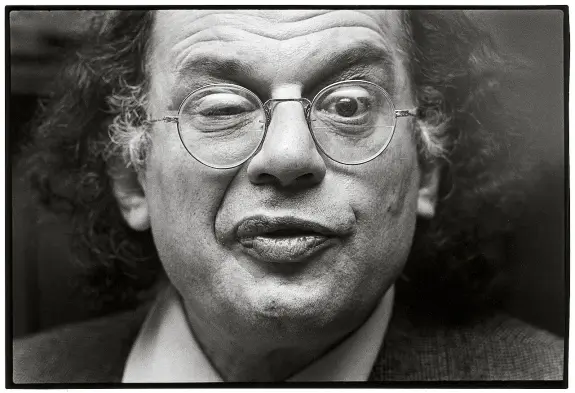
Before the Swinging Sixties came the “Fabulous” Fifties, an era of economic growth and post-war optimism. But from the cultural circuits of urban America emerged a literary revolution – the Beat Generation. This group of writers and poets rebelled against the status quo and had a not-so-secret psychedelic history that laid the foundations for the 60s psychedelic movement.
Non-conformist, anti-materialist, and laden with drugs, the bohemian Beats explored radical liberation through their writing, often fuelled by psychedelics.
Wrapped up in anti-establishment rhetoric, the Beats were some of the first writers to unapologetically showcase personal themes of sex, drugs, partying, and general debauchery.
The movement hugely influenced generations of creatives that followed, particularly when it came to opposing war, consumerism, and materialism – and to expanding consciousness.
The Beat Generation: A New Era
Jack Kerouac, Allen Ginsberg, and William Burroughs are key figures among many more in the Beat movement. They inspired a new wave of free-spirited youths who wanted to grab their dharma by the horns.
Despite rising out of US universities like Harvard and Columbia and being from wealthy roots, the writers were embedded in America’s underbelly.
Juxtaposing their backgrounds of academic rigour with stark realism, their contemporary writings contained unfiltered tales of madness: “junk” use, late-night parties, complicated relationships, the open road, and travels to far-out places.
Kerouac popularised the term Beat while attributing its origins to another of the movement’s writers, Herbert Huncke, who used it to describe those in difficult socio-economic circumstances (no money, no prospects).
According to a 1952 New York Times article titled “‘This Is the Beat Generation’”, Kerouac used “beat” to describe a downtrodden, or “down-and-out”, generation of youths. This generation was raised against the backdrop of the Cold War, where “the peace they inherited was only as secure as the next headline”.
Beat “...involves a sort of nakedness of mind, and, ultimately, of soul; a feeling of being reduced to the bedrock of consciousness. In short, it means being undramatically pushed up against the wall of oneself.”
With creeping Cold War paranoia quietly whispering between the pages of newspapers and echoes of God Is Dead sweeping through post-war America, the Beats were in search of enlightenment – whether it was in a chemical or in the mountains.
As well as championing a revolt against societal norms, the Beats also marked a radical shift in literature.
Their writing reflected their ethos of rebellion, breaking away from traditional structure and style, and infusing the personal chaos of life into spontaneous prose, gritty novels and confessional – sometimes lengthy – poetry.
As staples in San Francisco, California and movers on the New York jazz scene, the Beats experimented with free verse, spoken word, unconventional punctuation, and novel writing techniques that veiled stories within stories, often mirroring the off-beat rhythms of the music.
Embedded in both academic and cultural circuits, the writers planted a psychedelic seed that grew branches through the 60s, 70s, and beyond across music, writing, and politics.
Psychedelia and the Beats
The Beats were no strangers to psychedelics. Their mind-altering adventures began shortly after LSD was first synthesised in 1938, spanning through the 40s, 50s, and 60s.
Been there, wrote the poem. Benzedrines, heroin, amphetamines, weed, psilocybin, LSD, ayahuasca – you name it, the Beats probably tried it and documented it.
Inseparable from their non-conformist worldviews and quest for enlightenment, the Beat writers experimented with substances to help fuel their creativity and expression.
Writing both on drugs and about drugs, they were also explorers of Eastern philosophies and spirituality, searching for meaning in a bleak, industrialised society.
They were intricately linked with key figures in the psychedelic movement, such as Timothy Leary and Richard Alpert (Ram Dass), who often supplied the writers with psychedelic chemicals.
Ginsberg took mushrooms with Leary; Kerouac corresponded about mushrooms with Leary; and Burroughs criticised Leary for his evangelical approach to psychedelic use.
Both Ginsberg and Kerouac, alongside a collective of esteemed intellectuals (including Aldous Huxley, author of Brave New World, The Island, etc.), also took part in the Harvard Psilocybin Project that Leary and Alpert ran at Harvard University.
The research project aimed to document the effects of psilocybin on human consciousness but was eventually shut down over ethical concerns from scientific colleagues.
Many of the figures in the psychedelic movement revered the writing of the Beats, and their texts became a springboard for the psychedelic revolution of the 60s.
Burroughs: Junkie, The Yage Letters, Naked Lunch
William S. Burroughs was a pioneer of psychedelic tourism. He documented his drug use in grim and explicit detail, and explored altered states years before LSD hit the 60s scene.
DMT in Morocco, mescaline in Mexico, ayahuasca in South America (and so on).
His debut novel, Junkie, is the uncensored story of his heroin addiction, an addiction he described as “The Algebra of Need” – a virus that brought ruin on a person.
The Yage Letters and Naked Lunch by Burroughs are key psychedelic texts within the Beat movement.
The Yage Letters is a collection of Burroughs’ correspondence with Allen Ginsberg, detailing his quest to discover ayahuasca, travelling across Ecuador, Peru, and Colombia.
Burroughs hoped that ayahuasca might cure him of his addiction, describing the psychedelic drink as the possible “final fix”, where he may at last discover what he had been looking for in other substances.
Published in 1963, Burroughs documented his psychedelic adventures at a time when these substances had scarcely been written about in the global North (bar Gordon Wasson’s Life article ‘Seeking the Magic Mushroom’ and Aldous Huxley’s Doors Of Perception).
Chronicling his altered states of consciousness when on ayahuasca, he discusses its effect on the senses, on telepathy, and on creativity, unlocking new forms of perception and shattering Western world views.
The Yage Letters’ escapades also lay the foundation for his iconic novel, Naked Lunch.
Drawing on methods such as the DaDa cut-up (découpé) technique, Naked Lunch uses the letters as a basis for its wild and obscure narrative that dives headfirst into the dark realities of an attempt to escape addiction.
The book was so explicit in nature that it was banned in 1965 for being classed as obscene.
Burroughs gained notoriety when the book was brought to trial, and the judge ruled that Naked Lunch was “grossly offensive” but not obscene, after Ginsberg and other respected writers and intellectuals testified on the book’s literary merit.
At the trial, writer and journalist Norman Mailer described Burroughs as “possessed by genius” and likened the comic artistry of Naked Lunch to the surreal and psychedelic-like Renaissance painter Hieronymus Bosch:
“Just as Hieronymus Bosch set down the most diabolical and blood-curdling details with a delicacy of line and a Puckish humor which left one with a sense of the mansions of horror attendant upon Hell, so, too, does Burroughs leave you with an intimate, detailed vision of what Hell might be like, a Hell which may be waiting as the culmination, the final product, of the scientific revolution.”
This definitive psychedelic text, influenced by drugs in both its content and its style, helped shape a defining moment for censorship in the US.
While he never did rid himself of his opiate addiction, in the foreword of a later 1980s edition of Naked Lunch, Burroughs wrote that compared to the evil junk virus, hallucinogens were “sacred”.
Ginsberg and Flower Power
“America when will you be angelic? When will you take off your clothes? When will you look at yourself through the grave? When will you be worthy of your million Trotskyites? America, why are your libraries full of tears?” – Allen Ginsberg, ‘America’.
Allen Ginsberg was a renowned Beat poet and prominent political activist, widely known for his lengthy poems such as ‘Howl’ and ‘America’.
Ginsberg was heavily influenced by socialist ideals and openly criticised industrialism, war, and capitalist society, penning anti-war poems and chants.
Laced through his works and contrasting against his critiques of modern society were themes of liberty, enlightenment, Eastern spirituality, and nature, often in visionary and prophetic style, and deeply inspired by (and referencing) the works of William Blake.
‘Howl’, for example, spans both anti-war themes as well as altered states and ecstasy.
Ginsberg claimed he had a vision when reading Blake’s Ah! Sunflower, in which he heard Blake reading the poem to him in an “ancient, ancestral” voice. He later described his experiments with psychedelics as an attempt to recreate this visionary experience.
Ginsberg also combined his exploration of nature as divine with his use of drugs, and wrote poems while on LSD, such as ‘Wales Visitation’, penned on acid when he visited the Black Mountains (Wales, UK).
The poet’s political activism, married with his championing of spirituality and visionary style, was pivotal for the philosophical foundation of 60s psychedelia and the mass movement against the Vietnam War.
In an essay titled ‘Demonstration or Spectacle as Example, As Communication, or How to Make a March / Spectacle’, Ginsberg puts forward a suggested list of tactics for organising political marches.
One suggestion involved handing out masses of flowers to police, Hells Angels, and spectators as a visual spectacle to counter the breaking up of protests.
This tactic led to the infamous Bernie Boston Flower Power photograph of a young anti-war protester inserting a flower at the end of an officer’s gun.
A key figure on the political circuit, Ginsberg was also part of the “New Vision” poetry circuit devised by fellow Beat writer and journalist Lou (Lucien) Carr.
The premise of the collective was self-expression as creativity, expanding consciousness through altering the senses, and using art to “elude conventional morality”.
This new vision is as pervasive throughout the Beat movement as it is through the counterculture movements of the generation to follow, and Ginsberg’s psychedelic explorations turned people on to the potential mind- and spiritually expanding experiences of the drugs.
Kerouac, Cassady and the Merry Pranksters
Jack Kerouac is renowned for novels including The Dharma Bums, Big Sur, and On the Road, among a list of 11 other books.
Kerouac often detailed his own experiences of searching for meaning, drug use, and chaotic travels. In Big Sur, he documented the effect of his rapid rise to fame and his experiments with different psychedelics such as psilocybin mushrooms and mescaline.
Like Burroughs, Kerouac described mushrooms as “sacred”, and like Ginsberg, wrote on Zen Buddhism, themes of nature, and was concerned with the state of affairs in the US.
Kerouac’s good friend Neal Cassady was also a key figure on the Beat scene, and is widely credited with dubbing psilocybin as the “Rolls Royce of dope”.
Cassaday was immortalised as the character Dean Moriarty in Kerouac’s On The Road, a quintessential Beat novel that documents the travels of the movement’s writers through fictional characters.
His lengthy Joan Anderson Letter to Kerouac in 1950 inspired the spontaneous prose style of On the Road.
Cassady was a binding force for the Beat generation and 60s psychedelia movement. He joined Ken Kesey’s (author of One Flew Over the Cuckoo’s Nest) ‘Merry Band of Pranksters’, journeying on a colourful, psychedelic bus around California.
The Pranksters, along with the likes of Cassady, Ginsberg, and the Grateful Dead, would pick people up along the way and introduce them to LSD through their ‘Acid Test’ parties.
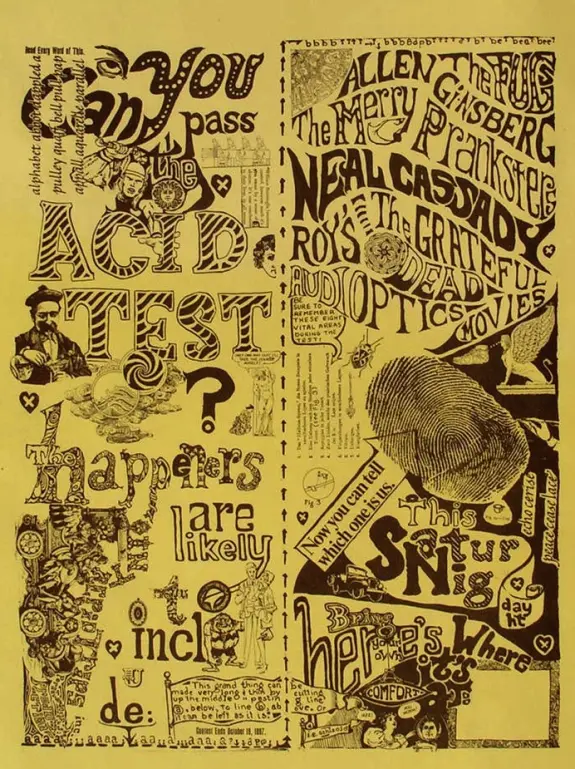
These psychedelic experiments featuring live sets from the Grateful Dead eventually led to Tom Wolfe’s famous book The Electric Kool-Aid Acid Test.
Kerouac, however, did not join the tests, and his relationship with psychedelics was more complicated than his Beat counterparts.
His most famous documented acid trip, guided by Leary, was a “terrifying” one. While he was strongly associated with using psychedelics and is widely revered as an instigator of the 60s counterculture movement, he returned to his Catholic roots in his later years.
The ultimate death of his friend Cassady left a sour mark on Kerouac against the movement he was immersed in.
In a TV appearance shortly before his own death, Kerouac claimed he did not intend to start the hippie movement, in the same way Dionysus did not intend to start the Dionysian movement, and that the Vietnam war was a “ploy to get Jeeps into the country by North and South Vietnam”.
In his last essay, published in the Los Angeles Times, Kerouac shared his disillusionment with both the establishment and the hippie movement:
“I'll try to forget that the hippie flower children out in the park with their peanut butter sandwiches and their live-and-let-live philosophy, nevertheless, are not too proud of being robbed of their simplified attempt at primitive dignity...”
Whether intentionally or not, Kerouac’s works had a lasting and defining impact on 60s psychedelic counterculture.
Shaping Psychedelic Culture
Beyond these key figures, other writers from the movement were also proponents of psychedelics and explorers of ecstasy and consciousness.
Beat writer Michael McClure’s ‘Peyote Poem’ documents his experience on peyote, exclaiming, “I am smiling. The pain is many pointed, without anguish” … “I am separate from gloom and beauty. I see all.”
Beat poet Diane di Prima was also embedded with Leary and spent time developing her spiritual and political philosophies, taking LSD and publishing Leary’s Psychedelic Prayers.
Beyond the politics, the psychedelic content of the Beats’ writings spawned inspiration for a plethora of artists, writers and musicians, including the likes of Hunter S. Thompson, Jim Morrison, and Bob Dylan, to name only a handful.
The movement’s calls for peace, its creativity, expression, and exploration of mind and spirit introduced people to new knowledge about a variety of different psychedelic substances and the experiences they induce.
While this article is merely a snapshot of the Beat Generation and its mind-altering experiments, the psychedelic history of the movement was a catalyst for the explosion of psychedelia in the 60s.