
Willie Thomas attended an Apache “mescal bean cult meeting” in the early 1900s. In a series of second-hand notes, he recounts doing a “mirace-jump” after eating the beans, jumping so high up that he went through the smokehole of the tipi. Amidst the backdrop of prayer and song, the Apache men followed him out the smoke hole, and some proceeded to walk barefoot across burning coals.
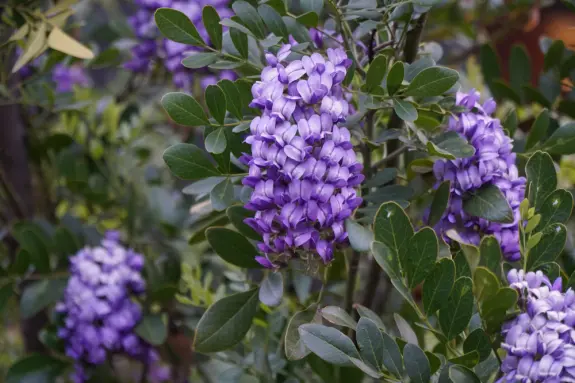
Texas Mountain Laurel, or Dermatophyllum secundiflorum, is a species of flowering shrub in the family Fabaceae. They contain leaflets, thick fruit pods, and vivid purple flowers that give off strong, sweet fragrances, which have been likened to grape soda and Kool-Aid. The fruit pods contain bright scarlet to maroon seeds, also known as mescal beans.
Today, Texas Mountain Laurel is mostly used as an ornamental plant. However, it holds a much richer significance within Native American history. For thousands of years, groups located in the Southwest United States and Mexico, where the plants grow endemically, formed cults centered around mescal beans. They were used in sacred initiation ceremonies, considered to be powerful medicines, and adopted as agents of spiritual protection in warfare.
Are Mescal Beans Psychedelic?
Mescal beans contain cytisine, which interacts with the same receptors in the brain as nicotine. Cytisine isn’t classically psychedelic, but recorded overdoses can include states of delirium and hallucinations similar to atypical psychedelics like Datura stramonium and Amanita muscaria. The experience of classical psychedelics can feel like an overlay on sense perception, or a portal to cosmic realms beyond. However, delirium involves vivid hallucinations that are often indistinguishable from normal waking life. The experience is often compared to psychosis, with individuals becoming confused, disoriented, and unable to reliably tell what is real.
“I had an indisputable realization that I was a medium through which divine messages should be sent,” describes a user on Reddit about his mescal bean experience. “Somewhere around 11:00, my chest started to feel as if I could not breathe, or swallow. I was having immense prophetic visions,… I felt as if I were a guru or oracle or some sort, that could no longer be of any use, and was dying.”
High doses of nicotine can also have significant visual and auditory effects, and tobacco is frequently used by various shamanic cultures for inducing trance states. People have described having visions and feelings of transcendence after using Rapé, a tobacco snuff. While cytisine doesn’t act as strongly at nicotinic receptors as nicotine, it may have shared overlap in these mystical effects.
Not all Native American groups appeared to use mescal beans for inducing visions or trance states. Rather, the majority appeared to be more concerned with the induction of vomiting as a means of purification. However, the beans came to be used widely across different cultures, each with its own unique uses and rituals.
Origins of the Mescal Bean Cults
The exact origins of the mescal bean cults are unclear, but scholars have argued that the greatest archaeological evidence lies in Southwestern Texas. They’re found in at least 12 prehistoric cave and rock shelter sites in the region, including the cave at Comstock shelter, where they’re located among an intriguing array of paraphernalia: rodent jaws, red pigment, flint knives, and the perforated shell of a terrapin.
Anthropologist T.N. Campbell suggested that mescal bean cults may have begun as early as 7500 BC among hunter-gathering traditions of the lower Pecos River region in Texas. He noted how the ancient rock art of the Pecos River people includes ceremonial dress, ritualistic objects, and animal iconography associated with the cults.
From Mescal Beans to Peyote
Along with other scholars, Campbell also theorised that mescal beans played a foundational role in the emergence of peyote ceremonies. The psychedelic peyote cactus is used far and wide as a religious sacrament among Native American groups. The Native American Church, a pan-Indian formalisation of peyote-using groups, is estimated to contain up to 400,000 members drawn from over 70 tribes.
The scholars argue that mescal beans gave these cultures pre-existing frameworks for ingesting psychoactive plants. Both mescal beans and peyote are associated with visions, spiritual insight, and healing, but mescal beans are far more toxic than peyote. As such, when the cactus started to spread from its desert home, it presented a practical response to mitigating harm. Many tribes moved from mescal bean to peyote use and showed evidence of a “transition period” in which both substances were used in tandem.
Purging and Spiritual Cleansing
Unlike peyote, mescal beans can be lethal at low doses. Ingestion causes unpleasant and often dangerous physical reactions, including nausea, vomiting, evacuation of the bowels, muscle paralysis, tremors, and increased heart rate.
A case report of a patient intoxicated with mescal beans reads: “In the Emergency Department the patient responded to verbal stimulation but only with single words. He had a fluctuating level of consciousness with intermittent agitation and was noted to be diaphoretic [excessive sweating].”
While these effects may seem utterly undesirable, many groups sought the emetic properties of Native Americans as a means of physical detox and purification.
“The only description given of the drug was that everything looks red to the drinker for a while then he vomits and evacuates the bowels, which the Indians say, cleans out the system and benefits the health,” wrote anthropologist Alanson Skinner, who was studying mescal bean use among Indigenous Iowa societies.
Killing the Beans
Skinner carried out short-term ethnographic fieldwork trips in the early 1900s and observed mescal bean ceremonies among Native Iowa people. He described how members painted themselves in white and wore split owl feathers on their heads. They prepared the mescal beans by “killing” them, roasting them near the fire, grinding them up, and turning them into a brew.
“The members then danced all night, and just past midnight they commenced to drink the red bean decoction. They kept this up until about dawn when it began to work upon them so that they vomited and prayed repeatedly, and were thus cleansed ceremonially, the evil having been driven from their bodies.”
Mescal Beans as War Aids
Skinner also wrote about the significance of mescal beans in war. Several Native Americans included the beans in “war bundles,” which were wrapped collections of spiritual and ceremonial objects. These objects were believed to provide supernatural powers and protection against injuries and misfortune. In addition to mescal beans, common objects of war bundles included tobacco, stones, animal parts, and feathers.
The Omaha, Indigenous peoples of present-day Nebraska, used mescal beans to aid in war by rubbing a concoction of the beans on their bodies before going into battle. They also rubbed it on their bullets “to make them kill the foe” and administered it to their horses.
Mescal Bean Initiation Ceremonies
The mescal bean cult of the Omaha was also known as the Witicha dance. In Siouan languages, spoken by many Native American tribes, the term “wíčhítha” can be associated with meanings such as “warrior,” suggesting that these dances may have functioned as initiation rites for warriors.
Ethnologist James Owen Dorsey described how, when a man received the calling, he invited others who possessed the “red bean medicine” to a feast. Two or three men prepared the beans over three days in secret. On the fourth day, the public ceremony was held in the earth lodge, where dances would take place, and the candidate symbolically “shot” with the beans.
Mescal bean initiations for the Pawnee people from present-day Nebraska and Kansas also involved dancing, and their cults have been called the “Pawnee Deer Dance society.” According to the anthropologist James Murie, the mescal beans were a source of spiritual power, including animal powers.
In his book, Pawnee Indian societies, he describes initiation ceremonies in which initiates are given a tea made from mescal beans that induces unconsciousness. Their spiritual endurance is tested in a painful ritual where a leader drags a toothed garfish jaw along their spine; if the initiate reacts, they are rejected from the society permanently.
The Relevance of Mescal Beans Today
Based on what is available online, mescal beans appear to have mostly fallen out of use. While a small number of psychonaut reports on Erowid describe isolated experiences in recent years, broader documentation of use seems to taper off after the 1960s.
This decline could reflect the replacement of mescal beans with peyote-based practices, but more broadly, the disruption and erosion of some Indigenous ceremonial cultures in which these plants once held meaning.
Nonetheless, ethnobotanical accounts suggest that mescal beans have not disappeared entirely from cultural life. Writer Elizabeth De La Portilla documents their continued use among curanderos and in folk traditions, where they are carried as protective amulets or incorporated into charms believed to ward off negative influences.
Moreover, there is a growing landscape for Native American-inspired peyote ceremonies, with revived interest in plant medicines and Indigenous spiritual traditions. The rituals, prayers, and dances possibly retain the essence of the mescal bean cults, even if facilitators and practitioners remain unaware. However, though the psychedelics market is ever-expanding, it’s unlikely that mescal beans will make a comeback, given their poisonous effects.
“Texas mountain laurel, with quinolizidine alkaloids being the primary (extremely deadly) toxins and psychoactive compounds, is one of the Great Old Men of plant lore and is therefore regarded as a manifestation of a great spirit of wisdom,” writes a user on Reddit. “That said, the best ritual usage for plants is just to love and respect them and help them live.”