

I didn’t know that I had aphantasia – actually, I didn’t even know what it was – until I was in my mid-20s and the topic became popular on social media. The discovery that I can’t visualize things in my mind’s eye, and that it’s an affliction that not everyone experiences, forever altered how I think and understand others.
Throughout childhood, I always thought it was a bit strange when people would say to close my eyes and visualize something. Surely they knew that there wasn’t actually anything popping up behind our eyelids, right? But they would go on, describing the vivid mental picture of the beach or concert or whatever their happy place was. Believing that they just wanted to see those things, I, in turn, played along, conjuring up a memory of a nice spot and seeing little more than brief, passing flashes of imagery off to the side, always just out of eyesight.
Although those of us with aphantasia are a rare breed, we are out there and, ironically, more visible than ever. Some researchers estimate that 1-5% of the global population lacks visual thoughts. There are pros and cons to this phenomenon, but there’s never been a potential “cure” available – at least, until now.
Understanding Aphantasia
Aphantasia’s definition is fairly simple: in a nutshell, it means that you can’t view anything in your “mind’s eye.” When a person with aphantasia closes their eyes to picture an object, place, person, or memory, they “see” nothing but a field of darkness.
The opposite of aphantasia is hyperphantasia, which produces visual imagery as vivid and real as what you perceive with your eyes open. They may read a book and view it in their heads like watching a movie, or visually remember every detail of their childhood bedroom. There’s an entire spectrum that lies between these two mental processes, with most people falling somewhere in the middle.
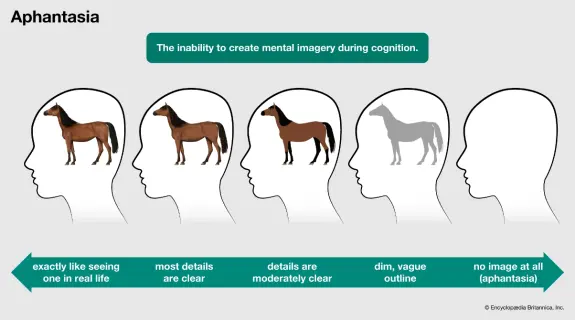
The concept of aphantasia is fairly new, exploding in reach online just within the last decade. The word itself was first used to describe this condition in 2015, only a few years after science first encountered and studied aphantasia. Since that first groundbreaking case, tens of thousands of people around the world have shared their own experiences, leading to a fresh burst of related research.
Witnessing the cutting edge of a new field of study is always exciting, and this one is no exception. Scientists are already uncovering some fascinating bits of knowledge regarding aphantasia. One of the first was that people who have it don’t have any difficulty performing tasks that were previously believed to need mental imagery. Those tested scored equally as well as people without aphantasia, which shocked the researchers and challenged what we know about brain function.
Some hypotheses have been put forth as to why this happens to certain people and not others. It’s been proposed to be genetic or perhaps result from brain damage, depression, or trauma. Others believe it’s simply a different way of thinking and processing information. For now, though, nobody truly knows what causes this phenomenon.
Can Psychedelics Open Your Mind’s Eye?
Much like the study of aphantasia, research into psychedelics is still a fairly new field. Although they have been a part of human history and culture for thousands of years, we’re just beginning to scratch the surface of how these substances work.
There is much to learn, but we have unlocked a few fascinating discoveries. In 2021, researchers at Yale discovered that psilocybin, one of the most long-used and revered psychedelics on the planet, can actually regrow neural pathways lost to depression.
Psychedelics also create huge shifts in how people perceive time, space, and self through varying interactions with brain chemicals or neurotransmitters such as serotonin. It can cause visual and auditory changes and hallucinations, sometimes entirely rewriting what a person sees in front of them.
So, if psychedelics can affect our outer perception so strongly, can they also impact our inner mind’s eye? Could a person with aphantasia close their eyes and view images while tripping?
Fascinatingly, yes. It doesn’t appear to work for everybody who experiences aphantasia, but a few intriguing stories have come out in recent years documenting people’s sudden ability to see mental imagery while under the influence.
In one case, a 34-year-old French woman who had never experienced internal imagery took magic mushrooms. As she began to peak, she realized that she was seeing more than just the world around her – she was seeing a new world within as well. At a follow-up a year later, she had continued to retain the ability to produce mental imagery.
Another case describes a South American man with lifelong aphantasia who took a single dose of ayahuasca (DMT). Thirty minutes later, he was picturing vivid scenes from his childhood and life that he had never been able to see before. Much like the French woman, his ability to see with his mind’s eye lasted after the drug wore off, albeit more faintly.
Tales From The Gray Matter
What people can see in their heads is very much a spectrum. So, too, is an aphant’s (aka: a person with aphantasia’s) ability to see mental imagery during a psychedelic trip.
There are extremes like the examples we discussed in the last section, but most people fall somewhere on the milder side of the spectrum. After taking psychedelics, many aphants see little more than minor visual changes, such as walls that breathe or shifting colors. Others see fairly standard psychedelic fare like mandala patterns, trails, or strong distortions in their field of vision. Some lucky people experience full-blown hallucinations and closed-eye visuals, just as someone without aphantasia would. This effect typically wears off with the high.
The subreddit r/Aphantasia is one of the few places on the internet featuring first-hand documented stories from real people with this condition, and everyone's experiences are a little different. In a post asking about personal trips, user slo1111 responded:
I can report that I can get visuals from psychedelics, both open eye and closed. The thing to note is that it is still involuntary. Open eye is overlayed. For example, looking at the sky, I could see the clouds, but I saw a geometrical overlay that gave the appearance of a dome over the sky. Closed eyes are like a kaleidoscope in that they morph…and are very geometrical.
Another user wrote:
Had a relatively high dose of psilocybin a few months back. Experienced a geometric mandala-type effect in grey, black, and red. I would describe it as dull but definitely present and prompted by visuals on the TV. The interesting aspect was there appeared no change whether my eyes were open or closed.
My personal favorite response, written by No-Frosting-4979, stated:
DMT is amazing. You can actually see things. Once I had an entity ask me why I could not see things in my head and then gave me the ability to visualise for 5 minutes.
But for every aphant who takes psychedelics with the intention of trying to open their mind’s eye, there are more who avoid psychedelics out of fear that they will do exactly that. Since aphantasia is actually believed to lead to better mental health (as it makes it harder for intrusive thoughts or traumatic flashbacks to break through), those who are susceptible to mental illnesses are more likely to steer clear. This theory is still relatively untested, yet real enough that some don’t view psychedelics as a worthy risk. Hopefully, additional studies will be developed in the coming years that provide deeper answers to these questions.
Final Thoughts
As someone who went most of my life without knowing that I had aphantasia, I sometimes wish I had never learned what it is. After finding out that you don’t experience thoughts the same way as other people, you almost feel like you’re missing out on something magical.
There is, however, something innately beautiful about experiencing mental imagery for the first time, much like an aphant might while taking psychedelics. I imagine it’s similar to the feeling a colorblind person gets when they try on colorblind glasses, or the emotions that come to a person who’s hard of hearing when they get their first hearing aid. I’ve gained a deep appreciation for the moments when I’m able to tap into my mind’s eye, and I certainly don’t take them for granted.
Whether or not psychedelics will ever be harnessed as a “cure” for aphantasia (or how many aphants would really want to be cured), their power to give people inner sight has only made them all the more intriguing and mystical. What does it say about how our minds work? Are they rewiring our brains on a chemical level, or are they allowing us to tap into a spirit world we will never understand?
For now, it seems only time will tell if we uncover the truth behind the legends. And I, for one, am very excited to see what we unveil next.