
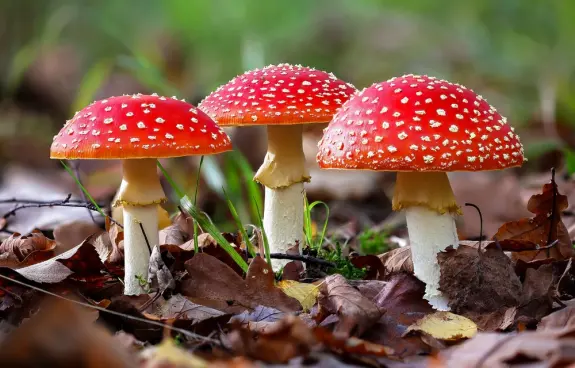
The intense red cap and white speckles of the Amanita muscaria mushroom make it perhaps the most recognisable mushroom on earth. The quintessential fairytale toadstool is a common element of European folklore, housing fairies and pixies and holding within it the potential of magic and mystery. However, behind this somewhat whimsical aesthetic lies an organism which is infamously toxic. For many years it was primarily understood as a poison. It did have a highly practical use, though. When the fungus is steeped in milk, it attracts and kills house flies. In the past, without the benefits of refrigeration, this would be a very valuable resource.
The mushroom also carries profound spiritual significance. The relationship between humanity and Amanita muscaria extends far beyond simple practical uses. In parts of Siberia and eastern Europe, indigenous populations consumed the mushrooms raw or made infusions from them to induce trance-like states and communicate with the spirit world. They did not consume the mushroom raw, developing specific preparation methods to avoid (at least some of) its toxicity. These methods would include drying the caps over fires or over a longer period in intense sunlight to purposely alter its chemical composition. This process was believed to reduce its physical risks and isolate its psychoactive properties. Indigenous users of Amanita muscaria possessed a deep relationship with the substance, and an understanding of its uses developed over many long years.
As with many other psychoactive substances, Amanita muscaria is experiencing a modern renaissance. A growing movement in the alternative health space is ignoring many years of European warnings of its toxicity. Throughout the wellness industry as a whole, especially in online communities, people are exploring the substance for its purported therapeutic benefits. A lot of this interest is focused on the practice of microdosing. Microdosing is the practice of consuming subperceptual amounts of the mushroom following careful preparation to reduce its inherent risks. Proponents of this usage make wide-ranging claims of the potential of these very small doses to alleviate conditions such as chronic anxiety, to manage stress and to significantly improve the quality of sleep. Predictably, this surge in interest has resulted in a new wave of commercial products within what amounts to a pretty much completely unregulated market.
As you might expect, this raises serious public health concerns. While both modern testimonials and historical anecdotal data are abundant, the medical community as a whole remains extremely sceptical. As products containing Amanita muscaria become easier to purchase and more widely available, there is an urgent need to separate the folklore from the pharmacological reality. Are the reported health benefits more than a simple placebo, or is this current trend a dangerous gamble with a well-known toxic substance?
Biochemistry and Psychoactive Compounds
To fully understand the perceived benefits of Amanita muscaria, we must carefully assess its complex chemistry. Unlike other psychoactive mushrooms, it does not contain psilocybin; instead, both its psychoactive and toxic effects are caused by a completely different set of alkaloids. These are primarily ibotenic acid, muscimol, and muscarine.
Ibotenic acid is known to be a powerful neurotoxin, which means that it alters, damages, or destroys the structure and function of the nervous system. When it is ingested raw, it acts as an agonist for glutamate, which is a naturally occurring amino acid in the brain. Glutamate plays a critical role in learning, memory, and cognitive function as a whole. This floods the nervous system with a rush of signals, which can lead to confusion, profound agitation, loss of muscle control, and gastrointestinal distress. Ibotenic acid is the dominant compound in the mushroom when it is consumed fresh. It is the primary reason that eating the substance raw induces severe illness rather than therapeutic effects.
Muscimol is the compound of interest in a therapeutic or spiritual context. It interacts with the brain completely differently from ibotenic acid. Muscimol is a powerful agonist for GABA receptors. GABA receptors are the main inhibitory neurotransmitters in the human body, so when muscimol binds to these receptors, the central nervous system is depressed rather than excited, as with ibotenic acid. This produces effects which are sedative, hypnotic, and potentially psychoactive. It actively slows down neural firing in the brain. This explains the deep relaxation and altered states of consciousness that are widely reported following consumption of Amanita muscaria. This is a very different experience to that of traditional magic mushrooms, which are often energetic, with vivid visual hallucinations.
Muscarine is the third prominent compound in Amanita muscaria, though it is only present in very small quantities. It is perhaps strange then that the mushroom is named after it, as muscarine plays a seemingly minor role in the overall experience. It triggers the neural pathways which connect the central nervous system to the rest of the body. This can cause physical symptoms like sweating, salivation, and even the production of tears.
The means by which the inherent toxicity of the substances contained within the mushroom and its potential therapeutic benefits lie in a chemical reaction known as decarboxylation. This is usually achieved by subjecting Amanita muscaria to heat, an acidic environment (like the stomach) or prolonged drying. The reaction causes the ibotenic acid, the main toxic ingredient in the mushroom, to convert to muscimol. Decarboxylation is the exact mechanism that historical cultures utilised when they dried the caps over fire. If done correctly, decarboxylation markedly reduces the potential toxic effects and maximises the sedative and psychoactive properties of the substance. The understanding of this chemical conversion is the foundation of any modern attempt to use Amanita muscaria safely.
Neurological, Psychological, and Pain Relief Claims
Many of the modern therapeutic claims surrounding Amanita muscaria are seen to be a result of muscimol’s interaction with the brain. Its interaction with GABA receptors to dull neural activity is not unique to the mushroom. Many well-used pharmaceutical sedatives such as benzodiazepines and certain sleep medications interact with the same neural pathways. This means that the physiological basis for using Amanita muscaria to treat conditions like anxiety, stress, and sleep disorders does seemingly make sense scientifically.
This potentially explains why modern microdosers of the substance often report improvements in their sleep and a reduction in their anxiety symptoms. However, bridging this gap between theory and a safe and proven medical treatment is very difficult. Recent literature reviews have highlighted a definite contrast between the seeming pharmacological potential of the substance and clinical reality. While animal studies have demonstrated that isolated muscimol can certainly reduce anxiety behaviours and induce sleep, clinical trials in humans are non-existent. So while the medical community acknowledges the mechanism of action of the substance, it is a long way from verifying its efficacy, optimal dosage, or long-term safety, especially while consuming the whole mushroom as opposed to the isolated substance.
Aside from the potential psychological applications of Amanita muscaria, researchers are also investigating its potential to alleviate symptoms of inflammation and chronic pain. In laboratory settings, extracts of the mushroom have demonstrated measurable anti-inflammatory properties. This suggests that it may be effective in managing conditions like arthritis, which are characterised by swelling and pain in the joints.
The physical reduction of inflammation combined with depression of the central nervous system likely explains the widely reported pain-relieving effects of the substance. This is a dual mechanism of action: a reduction of inflammation and a lowered ability to perceive pain itself. However, though there is a lot of anecdotal data for these effects, the relative lack of clinical data means it cannot be reliably or safely prescribed or recommended by medical professionals. When you stand back and assess the fact that people are using an inherently toxic fungus to manage an increasingly wide variety of symptoms, it is unsurprising that the effects are highly unpredictable, regardless of its seemingly promising biochemical profile.
Dermatological and Topical Applications
While the injection of Amanita muscaria carries potentially severe risks, another method of administration is growing in popularity. The topical application of extracts of the substance has a long history of usage in traditional medicine. For many years, herbalists in Eastern Europe and Russia have formulated tinctures and salves by infusing Amanita muscaria into alcohol or oil. These preparations were commonly rubbed directly into the skin to tackle muscular pain, aching joints, and inflammation. This practice is experiencing a commercial revival. There is a rapidly growing market of various balms and creams which are advertising the mushroom as a remedy for conditions like arthritis, sciatica, and a wide variety of skin conditions.
The primary appeal of topical applications as opposed to ingesting the substance is the significant reduction in risk. If ibotenic acid and muscimol are consumed directly and enter the digestive system, they rapidly enter the bloodstream and easily cross the blood-brain barrier. Applying these compounds to the skin is far safer, as there is no means for them to enter the bloodstream and therefore the brain. This means it may be possible to harness its potential anti-inflammatory and analgesic effects without risk of poisoning or unwanted psychoactive experiences.
Again, the scientific literature relating to these dermatological claims is lacking, but some early studies offer potential clues. Research shows that extracts from Amanita muscaria can produce measurable anti-inflammatory effects. When applied to the skin, ibotenic acid and muscimol may soothe irritation. On top of this, the mildly analgesic properties of the mushroom may dull the nerve endings near the surface of the skin, potentially providing relief for aching muscles. Once again, despite these promising mechanisms of action, any evidence for these effects relies heavily on anecdotal data, traditional knowledge and very preliminary laboratory testing as opposed to large-scale controlled human trials. Until much more rigorous clinical data is available, the efficacy of creams containing Amanita muscaria or its constituents remains a subject of ongoing scientific debate rather than a proven dermatological treatment.
The Clinical Evidence
The disparity between historical and modern anecdotal data and clinical validation is a significant hurdle facing research into Amanita muscaria. Online forums are awash with extremely detailed personal accounts of both physical and psychological healing. Users consistently report profound relief from anxiety, chronic pain, and insomnia. Nevertheless, anecdotal data, however widely spread and abundant, is not clinically significant. There is almost a complete absence of tightly controlled human clinical trials investigating the substance.
The inherent toxicity of the substance is what has limited the current clinical landscape. While the ongoing psychedelic renaissance has increasingly encouraged large institutions to fund research into classic psychedelics such as psilocybin, Amanita muscaria has a very different risk profile. Psilocybin (or psilocybin containing mushrooms) has an extremely low physical toxicity and a seemingly wide variety of powerful therapeutic effects; Amanita muscaria is much more potentially dangerous. The difference between what is considered to be a microdose and one which is potentially toxic is both very small and highly variable. This makes standardisation, which is the primary concern of clinical trials, very difficult to achieve.
Researchers are not able to ethically administer a substance which is known to be a highly variable toxin to human subjects without strict safety protocols. Studies have thus far almost exclusively focused on isolated compounds tested on animals, or in vitro studies in laboratory settings. This does not validate its efficacy or safety for a human consumer, especially of the whole substance or an extract thereof, as opposed to the isolated compound.
This lack of human data creates a potentially very dangerous grey area. In the absence of clinical guidelines, consumers are left to explore a market which is unregulated, relying on secondhand and solely anecdotal data sourced from potentially unreliable or commercially focused entities. Medical professionals do not have the data necessary to recommend the substance for any condition. Until researchers can isolate the active compounds, standardise the dosage and conduct large-scale human trials, Amanita muscaria will remain an alternative medicine rather than a proven clinical therapy.
Final Thoughts
The future of research into Amanita muscaria lies in the consistent and effective isolation of its chemical components from its unpredictable natural form. While the mushroom seemingly contains compounds which have genuine pharmacological potential, consuming the substance whole remains an unacceptable medical risk. Historical traditional and folk knowledge as well as modern anecdotal reports point towards potential tangible benefits for conditions like anxiety, insomnia, and pain relief.
With the lack of clinical data, though, these claims remain unvalidated.
To harness any viable and therapeutic value from Amanita muscaria, the scientific community will have to look beyond the mushroom in its raw state and focus solely on its isolated alkaloids. Muscimol is certainly of significant interest due to its status as a powerful GABA receptor agonist. Any future pharmacological developments will more than likely involve the synthesis of the substance in controlled laboratory environments. This would allow researchers to ascertain a specific effective dosage, eliminating the potentially severe neurotoxic threat posed by its other constituents (ibotenic acid, muscarine). Isolation, synthetic reproduction and large-scale clinical trials will be the only way to truly assess the validity of the perceived therapeutic potential of the mushroom.
For now, the gap between its purported benefits in the alternative health space and established public health warnings will remain. An unregulated commercial market rapidly increasing in scale has outpaced the progress of the science assessing its safety. Medical consensus continues to assert that the inherent variability of the constituents of the mushroom makes it fundamentally unsafe for any form of self-medication. A future in which these compounds are integrated into standardised psychiatric or analgesic care will require a complete departure from crowd-sourced home preparation methods and the online wellness market. Evidence-based pharmacology, patient safety, and chemical standardisation must be prioritised, regardless of folklore, both modern and historical.