
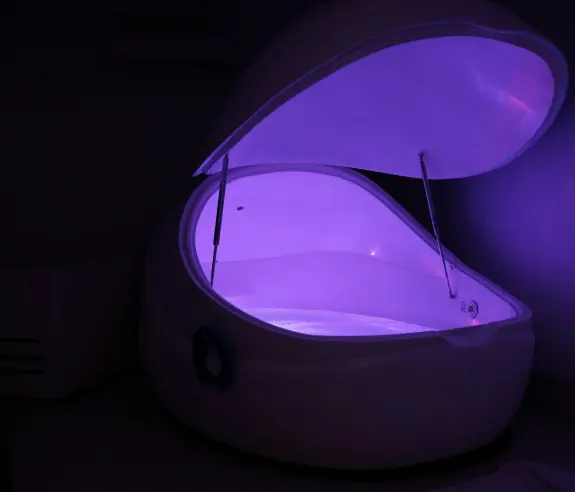
Invented by eccentric scientist John C. Lilly, the sensory deprivation tank was developed to explore the human brain.
Obsessed with understanding consciousness, neuroscientist, physician, and psychoanalyst John Lilly spent the majority of his life conducting experiments that aimed to answer questions about how it works.
This included exploring interspecies consciousness, which made him infamous for his controversial experiments administering LSD to dolphins at his centre known as the Dolphin House. The experiments aimed to discover if the compound could facilitate interspecies communication between the animal and humans.
His invention of the sensory deprivation tank was a bid to uncover an answer to a debate in neuroscience in the 1950s. At the time, scientists suggested that the brain would stop functioning if it received no input.
Otherwise known as a float or isolation tank, the sensory deprivation tank is a vat of water containing large quantities of Epsom salt to enable floating, and was designed by Lilly to remove all external sensory stimuli in order to answer this question and see how the brain would respond to this environment.
Contrary to the mainstream thought at the time that the brain would cease to function, Lilly discovered that the brain would actually respond to a lack of stimuli by becoming more active – even producing altered states of consciousness.
The Science on Float Therapy
Research has found that time in sensory deprivation tanks, often referred to as Restricted Environmental Stimulation Therapy (REST), impacts the brain and body in a number of different ways.
For example, the first functional neuroimaging investigation of Floatation‐REST conducted in 2025 found that a 90-minute session of the therapy reduced communication in the default mode network (DMN) – an area of the brain associated with reflection and rumination. Science shows that this reduction in DMN activity is linked to improved mental well-being by reducing worry and rumination.
A recent review of research into sensory deprivation also found that short-term sensory deprivation can trigger structural and functional brain changes, neural adaptations such as the reorganisation of synaptic connectivity, and lead to reduced anxiety and improved interoception and mental well-being.
The review authors suggest that these effects are caused by reduced cortisol levels and reduced sympathetic arousal, writing that “in ancient cultures, sensory deprivation was often used for spiritual or therapeutic purposes” such as in ancient Greece, where “isolation was one of the treatments of insanity” and in Tibetan Buddhism, which uses “dark retreats for deep introspection”.
Furthermore, studies have found that Float-REST can impact hormones. For example, a meta-analysis of 27 studies that investigated the physiological effects of the therapy found that study participants displayed lower levels of the stress hormone cortisol, lower blood pressure, and improved well-being and performance, suggesting that “flotation REST can be a useful stress management tool in addition to or instead of other stress management tools”.
Floating and Altered States
Beyond these effects on the brain and body, research shows that float tanks or Float-REST can induce altered states of consciousness.
In a study of 50 subjects that took part in 60 minutes of Float-REST, the therapy caused altered states such as loss of physical body boundaries and the distortion of time, which the researchers found to be associated with anti-anxiety effects.
A further “micro-phenomenological” analysis of Floatation-REST from the study provided phenomenological reports of these altered states, with participants reporting loss of orientation, altered body perception, and trance-like states.
The analysis reports participants' descriptions:
“And (…) at that moment, somehow, um, my body became a bit blurred with the water. So again, this extreme blurring of boundaries, yes.”
“[…] And I saw, (…) I don’t know, it’s difficult with my eyes closed, (…) but I felt-, I felt, (…) ah I’m just fully back again, (…) like such bright points of light-, (…) and also, also, I, well, at least a part of me consisted of this light.”
“Um, (…) and what I found amazing was that I didn’t even notice the other (areas of my body), well, I don’t know, the stomach or whatever. And that was somehow also very pleasant. So not feeling the whole thing anymore, so to speak, but that it melted away.”
Further online reports from altered state archives such as Erowid sometimes describe more intense experiences such as:
“Curiously, there was quite a bit of visual activity going on for me while in the tank. However, none of it was representational or really all that interesting. It seemed like phosphene activity, much like pressing on my eyeballs, with mutating smears of formless color and light. At one point, a very distinct image of a lamp from my childhood home emerged, and it was so vivid, and clearly seen--not imagined--that it seems worth noting as a cognitive effect.” Mink Snopes. "Time in the Tank: An Experience with Floatation Tank (exp68367)". erowid.org/exp/68367. Jun 18, 2012.
“5-10 min.- Closed eyed visuals become prevalent. Open-eyed visuals become same as closed. Cannot tell at times whether eyes are open or closed.
Only physical experience at this time is my heart beat (which feels as though it is slightly elevated. Have no way to measure this) and my respirations (which appear to be decreased, again cannot measure this).
10-60 mins. Time extremely distorted during this period- "organic machinery" patterning present in back ground. Visual of an eye fills vision. I'm absorbed by the eye.
When I focus on my breathing I can "see" my breath as a grey, blue mist filling gaps or being absorbed into the background patterns.
Quick eratic thoughts of self, consciousness, subconsciousness appear and fade very quickly. Cannot grasp or explore these thoughts despite trying.
Travel to several places-
Flying over a mountain side- distinct impression of Mayan setting but I have no idea why I "know" this, visually this is nothing that would imply this.
Find myself high above what was surely Stonehenge. Find this very entertaining as this seems like very stereotypical imagery, I remember laughing out loud at this image. Also strange as this is something I rarely consciously think about.” Rollingstone. "First Float Surprisingly Profound: An Experience with Floatation Tank (exp112884)". erowid.org/exp/112884. Apr 4, 2019.
My Float Experience: Auditory Hallucinations?
I have personally had what I think was an “altered state” experience from a float tank about ten years ago.
My first time in a floatation tank was initially relaxing but nothing particularly special, or so I thought at first.
I dunked into the egg-shaped tank and began to relax into my float as the lights dimmed and the sounds of the forest playing through speakers lowered in volume and disappeared.
A regular meditator, I began to settle into my meditation to explore what the experience may be like in a sensorily deprived environment.
While my meditation was as it usually was, my one hour in the tank was over in what really felt like a flash. I was shocked when the lights and sounds came back, thinking I had surely only been in the tank for ten minutes.
Following the float, I was invited to relax in a secluded room where I was brought a tray of raspberry sorbet, dark chocolate, and raspberry tea to bring my senses back. I was left to enjoy them alone.
The sorbet hit, and my mouth burst with water: juicy, tart, crisp, fresh, cold raspberry sorbet, crackling like sherbet on my tongue. The fragrant tea washed it down to make way for the bitter but creamy, fruity dark chocolate.
As I was enjoying this heightened and ultra-delicious sensory experience, I suddenly began to hear the most beautiful woman’s singing voice I had ever heard. Accompanied by soft and soulful piano notes, I was aghast at the talent and exquisite nature of what I was hearing. Tears welled in my eyes.
I didn’t know where it was coming from. It was so clear and crisp in the room, but there were no speakers or sound system in the room. This woman must surely be just behind the wall.
I popped my head out to check – no doors, no other rooms, just the narrow corridor leading to the front of the building.
When the float host came to collect me and the finished snackboard, I asked him where the music was coming from, to which he replied, “What music?”
So, explaining what I heard, I asked if people lived behind the building or if there was maybe a theatre or music school next door. Emphasising that the area behind the building was near enough to a building site, the host asked me if I had trouble with my hearing.
Sure enough, I have been partially deaf in one ear since I was very young.
He explained to me how the brain can often create auditory hallucinations in individuals who have reduced hearing, particularly after sensory deprivation, as the brain creates its own auditory signals to compensate for the lack of input.
For example, a case study found that an 81-year-old woman with hearing difficulties began to experience “musical-type” hallucinations. The report explains that these hallucinations were of songs she had learned in childhood.
“She heard them in her left ear, which was the only one that still retained partial audition with a hearing aid. She had not heard anything with her right ear for several years. The songs could last for hours and did not bother her; she assumed they came from the outside environment.”
While not a particularly psychedelic experience, this supposed hallucination I experienced was very beautiful and sounded very much as though it was in the outside environment.
While research shows that floatation tanks can help improve wellbeing, these experiences of altered states in floatation tanks also show that the brain is incredibly adaptable and has a unique way of compensating for lack of sensory input.