
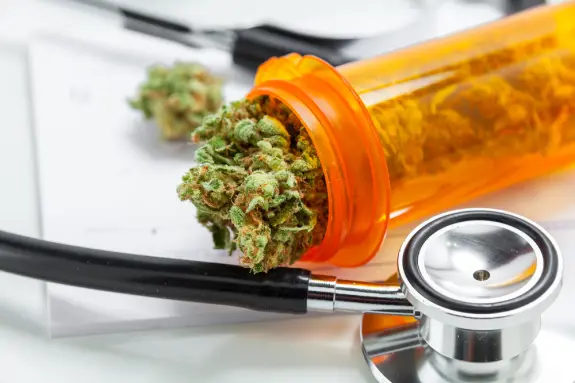
Medical cannabis has been legal in Britain since 2018. Reform came with the case of Alfie Dingley, a child whose dozens of daily seizures were relieved by cannabis, which forced the government's hand.
Cannabis is approved for a narrow range of conditions. Cannabidiol (CBD) is licensed for a small number of severe childhood epilepsies; THC:CBD spray has a defined role in moderate-to-severe MS spasticity when other treatment has failed; and nabilone may be considered for chemotherapy-induced nausea. Before 2018, patients seeking relief from cannabis had to buy or grow it illegally, risking prosecution, adulterated products, and supply chains involved in slavery.
The hopes of reformers have not translated into NHS provision. Fewer than five NHS prescriptions for unlicensed cannabis medicines have been issued since 2018. Almost everyone using cannabis legally in Britain pays a private clinic, often at high prices that might drive them back to black market purchases. An industry of more than 40 such clinics has filled that gap. Many clinics have a mental-health offer, including conditions like anxiety, depression, PTSD, ADHD, OCD, autism, and eating disorders, for which cannabis is ill-evidenced and potentially harmful.
Selling a Mental-Health Medicine That Isn't One
A 2026 systematic review and meta-analysis of randomised trials, published in The Lancet Psychiatry, found no significant benefit for anxiety or PTSD and no trials at all for depression. The review concluded that routine cannabinoid use for mental disorders is rarely justified on current evidence.
A separate American College of Physicians review found harms likely outweigh benefits specifically for people with serious mental illness.¹ The US National Academies' review of more than 10,000 studies found limited evidence to support cannabis in treating mental health conditions. The 2025 AHRQ living review found only small short-term pain improvements for some THC:CBD products, alongside moderate-to-large increases in dizziness, sedation and nausea, “insufficient to draw conclusions”. A 2026 Cochrane review found no clear evidence that THC-dominant, balanced or CBD-dominant medicines produce large relief in chronic neuropathic pain. The National Institute for Health and Care Excellence advises against offering THC, THC:CBD combinations, nabilone, or dronabinol for chronic pain in adults in the circumstances.²
Longitudinal evidence indicates that cannabis use predicts later depression, with the risk around a third higher than non-users. Suicide attempts may be three and a half times higher in heavier users, though results vary considerably by study. The evidence for direct causation is less certain because people may use cannabis to manage pre-existing symptoms. Both depression and heavy use may be explained by a third factor, like poverty and adverse childhood experiences. Still, a systematic review found that daily or near-daily use of cannabis among adolescents was associated with a 70 per cent higher risk of psychosis compared with non-use. Among heavier users, the risk may be around four times higher. UK registry data suggest that flower-using medical-cannabis patients may commonly report roughly 5–10 g of flower per week, passing the threshold for heavy use. No robust UK-wide average THC concentration has been published.
Against this inconclusive evidence base, Alternaleaf's UK site boasts that it has “prescribed medical cannabis for more than 50 conditions”. Its Australian parent markets “over 140” conditions.³⁴ Many clinics market cannabis for mental health conditions. Many clinics, including Alternaleaf and Curaleaf, also require a pre-existing diagnosis and two failed conventional treatments before assessment.
Clinics report likewise screening out applicants with histories of bipolar disorder or psychosis. Airmed will screen out those whose only prior treatment was talking therapy. Still, a clinic like Medicann promotes the drug to “over 50 conditions,” including anxiety, PTSD, ADHD, and autism, on a Channel Islands entity with no UK inspection record. CB1 Medical's “Mental Health” page states cannabis “can be prescribed for” depression, generalised anxiety disorder, mixed anxiety and depression, social phobia, panic disorder, agoraphobia, OCD, and ADHD, introduced with the mechanistic claim that cannabis “interacts with the endocannabinoid system... to improve mood, reduce anxiety and stress levels”. Can° Clinic markets across “20+ psychiatric and neurological conditions” including ADHD, autism, and depression, while Lyphe runs mechanism-led landing pages aimed specifically at PTSD, OCD, and eating disorders behind a low-cost, pay-as-you-go entry point.⁵
Prospective patients with LeafEase are presented with a variety of positive evidence for mental health conditions. Their website auto-displays an image of a patient in pain ‘BEFORE CANNABIS’, meaning “everyday tasks can feel impossible”. “AFTER CANNABIS”, the patient in the image – which appears to be generated with artificial intelligence – is shown happy and comfortable, and “everyday tasks can feel possible again”. While cautioning about the early-stage nature of research, and emphasising the risks involved, Elios described cannabis as potentially helpful for schizophrenia. “[I]t is believed that medical cannabis can improve cognitive function and enhance quality of life in patients with schizophrenia”, the blog read, which has since been taken down. It is not clear that the clinic prescribes cannabis for this indication. Elios did not respond to requests for comment. The website warns elsewhere on its own site that high-dose THC can raise psychosis risk and worsen the disorder.⁶ Zerenia's OCD material cites a short-term study conducted by the company as support for prescribed treatment, and describes side effects as “usually mild”.⁷
Curaleaf's public condition directory extends to anxiety, depression, ADHD, autism, and eating disorders, while its own practitioner-education material, aimed at clinicians rather than patients, is markedly more circumspect about the same indications.⁸ Mamedica has told The Times that a majority of its 12,500 patients present with psychiatric conditions, framing cannabis treatment as potentially “game-changing”.⁹
Not every clinic runs the same funnel. Integro, for instance, despite marketing into the same “50+ conditions”, is built around chronic pain and oncology and excludes anyone with a personal history of psychosis or schizophrenia.¹⁰
The marketing can follow a patient off the clinic's own website. The reporter's Facebook data export shows releaf.co.uk's tracking pixel fired three events within ten minutes of a single site visit in May 2026, and Meta's advertiser-disclosure file lists Releaf among companies using that activity for ad targeting. Repeated SMS messages, emails, and Facebook adverts from Releaf, promoting consultations, followed for months afterwards.¹¹
Academic research on personalised marketing identifies targeting people at moments of health-related vulnerability as a potential form of exploitation that current consumer-protection law struggles to address.¹² Releaf's own Chief Legal and Compliance Officer, Rupa Shah, has said the clinic markets its service rather than the drug itself because of “unique restrictions on advertising” a prescription-only medicine. Oliver Robinson's brother Alexander, who has separately written to the Health Secretary about cannabis-clinic advertising, argues this distinction between the drug and its consultation service is illusory.¹³
The Case of Oliver Robinson
Oliver Robinson, a 34-year-old with a history of depression and psychiatric admissions, was prescribed high-strength cannabis by Curaleaf and enrolled on the company's own registry study. He died in 2023, consuming street cannabis alongside his prescription: a combination Curaleaf was not aware of. Manchester coroner Catherine McKenna concluded in January 2026 that his prescription was inappropriate and contributed to his death. The cannabis was issued by a Curaleaf psychiatrist the coroner found lacked adult-psychiatry experience appropriate to his case, who has since been referred to the General Medical Council. Put directly to Curaleaf, the clinic said it had since gained access to the NHS Spine database for more contemporaneous records, strengthened governance around complex psychiatric presentations, and changed its record system to track community mental-health team engagement. They added that “every prescribing decision at Curaleaf Clinic is made by a multidisciplinary team... and not by any single clinician.”
The sector's trade body, the Medical Cannabis Clinicians Society, told The Times the case had prompted a “substantial revision” of its prescribing guidelines and cautioned against “drawing conclusions about the quality or safety of care from prescribing volume alone.” Curaleaf still promotes cannabis for mental health conditions.¹⁴ Curaleaf’s formal response does not explain why prescribing continued for a further seven months after an NHS psychiatrist diagnosed Robinson, in April 2023, with a “Mental and Behavioural Disorder due to Cannabinoid Dependency.”
Wellford's website states that “most patients do not experience side effects or feel high”. Its strongest product has a 34% THC concentration. High-dose THC is expected to impair memory, attention, psychomotor performance, and judgement, and raises the likelihood of anxiety, panic, paranoia, and transient psychotic-like effects. Asked directly, Wellford said treatment is individually titrated, and risks are discussed before prescribing and reviewed again at four weeks.¹⁵ As Sir Robin Murray, professor of psychiatric research at King's College London, put it to The Times: “One doesn't go to a clinic called after the name of a drug... here we have clinics set up to prescribe what the patients say they want... irrespective of whether there is any evidence that cannabis can help the complaint.”¹⁶
Endnotes
1. Wilson, J., Freeman, T. P., et al. (2026). The efficacy and safety of cannabinoids for the treatment of mental disorders and substance use disorders: A systematic review and meta-analysis. The Lancet Psychiatry, 13(4), 304–315. American College of Physicians (2025). Cannabis or cannabinoids for the management of chronic noncancer pain: best practice advice.
2. National Academies of Sciences, Engineering, and Medicine (2017); AHRQ (2025) living systematic review on cannabis for chronic pain; Cochrane Database of Systematic Reviews (2026) on cannabis-based medicines for chronic neuropathic pain; NICE, Cannabis-based medicinal products, NG144 (updated 2021).
3. National Academies of Sciences, Engineering, and Medicine (2017). The health effects of cannabis and cannabinoids – the source of the conclusive/substantial/moderate/limited/insufficient evidence tiers referenced here, summarised in Abrams, D. I. (2018), European Journal of Internal Medicine. Condition-marketing claims are drawn from clinic websites captured in August–September 2026.
4. Care Quality Commission, Winnersh, Montu Group UK Ltd, assessment report, assessment dated 22–29 July 2025, published 27 February 2026. Therapeutic Goods Administration, "Court proceedings initiated against Montu Group Pty Ltd, Alternaleaf Pty Ltd, and an individual for alleged unlawful advertising of medicinal cannabis" (April 2024); proceedings were reported as ongoing as of mid-2026, and the allegations have not been determined by the Federal Court of Australia. Alternaleaf's right-of-reply correspondence appears at Part Two, note 5. A 2025 CQC assessment of Alternaleaf found that patients were “encouraged to choose products from the entire formulary offered by a partnered pharmacy, with no guidance on which types might be most suitable for their condition,” and selections “were not reviewed by the specialist responsible for the patients' care.” In Australia, the medicines regulator alleges Montu and Alternaleaf's parent, and a named director, represented cannabis as “magical or miraculous” and made "restricted/prohibited representations" about treating serious diseases – allegations that remain contested and undetermined by the Federal Court
5. Medicann, CB1 Medical and Can° Clinic (Cantourage Clinic Ltd) condition and marketing claims are drawn from clinic websites captured August–September 2026. Medicann and CB1 Medical were sent right-of-reply questions for this article; neither appears to have substantively responded. Lyphe's landing-page marketing and pricing are drawn from its own site; Lyphe was sent right-of-reply questions about its marketing and does not appear to have substantively responded (see Part Two, note 4).
6. Elios Clinics Limited was sent right-of-reply questions for this article; no response appears to have been received.
7. Zerenia Clinics Limited was sent detailed right-of-reply questions, including on the Colombian study referenced later in this article; no substantive response appears to have been received.
8. Curaleaf's public condition directory and its separate practitioner-education materials were both reviewed for this article, captured August–September 2026. Curaleaf was sent right-of-reply questions on this specific gap; its response, given in the context of the Oliver Robinson case, is set out in full below.
9. Andrew Ellson, “Ten doctors have prescribed half of all cannabis drugs,” The Times, 29 March 2026. This publication asked Mamedica directly, in its original right-of-reply letter and again in a follow-up, what proportion of its patients or prescriptions relate to a psychiatric indication; no figure was provided on either occasion.
10. Integro and Airmed's eligibility criteria and marketing are drawn from their own websites and application materials, captured August–September 2026. Both were sent right-of-reply questions for this article; neither appears to have substantively responded.
11. This reporter's own Meta (“Download Your Information”) export, generated 31 July 2026, recorded a PAGE_VIEW event and two CUSTOM events sharing a single Event ID at releaf.co.uk on 23 May 2026 (11:23 am, 11:28 am and 11:33 am), and listed Releaf in the “advertisers using your activity or information”. The SMS messages and subsequent Facebook adverts described are recalled by this reporter from the same period; no screenshots were retained.
12. Strycharz, J., & Duivenvoorde, B. (2021). The exploitation of vulnerability through personalised marketing communication: are consumers protected? Internet Policy Review, 10(4). https://doi.org/10.14763/2021.4.1585.
13. Rupa Shah, Chief Legal and Compliance Officer at Releaf, quoted in Business of Cannabis (21 January 2026) and on Releaf's own blog, on the advertising restrictions clinics operate under. Alexander Robinson's letter to the Secretary of State for Health and Social Care is referenced at Part Two, note 17.
14.Oliver Robinson: Prevention of future deaths report, Regulation 28 report, ref. 2026-0058, Coroner Catherine McKenna, Manchester North, dated 4 February 2026, following an inquest concluding 30 January 2026 with a finding of misadventure. Curaleaf Clinic, represented by Third City PR (Freya Bugeja), provided the full on-the-record statement quoted here by email on 22 July 2026, and its formal Regulation 28 response is published on the Judiciary website; that formal response disputes several of the coroner's findings, including the characterisation of Dr Bhoskar's qualifications, in more detail than the statement given to this publication. Dr Urmila Bhoskar's referral to the General Medical Council and the Medical Cannabis Clinicians Society's response to The Times are both reported in Andrew Ellson, “Ten doctors have prescribed half of all cannabis drugs,” The Times, 29 March 2026. Curaleaf's 2024 CQC assessment is discussed further at Part Two, note 16.
15. Wellford's website copy and formulary range are drawn from the clinic's own site, captured September 2026; its CQC location listing is marked “not yet inspected.” Wellford, represented by M&F Health Communications, answered a detailed right-of-reply questionnaire largely in full on 20 and 25 August 2026, stating that "each patient's treatment is individualised and carefully titrated," that patients are informed of risks including "psychoactive effects, impairment, driving, interactions with alcohol and other medicines, mental health effects and dependence" before prescribing, and that a follow-up review occurs after four weeks. It maintained that the “most patients” claim reflects its clinical experience rather than a formal audit.
16. Sir Robin Murray, quoted in Andrew Ellson, “Ten doctors have prescribed half of all cannabis drugs,” The Times, 29 March 2026.