
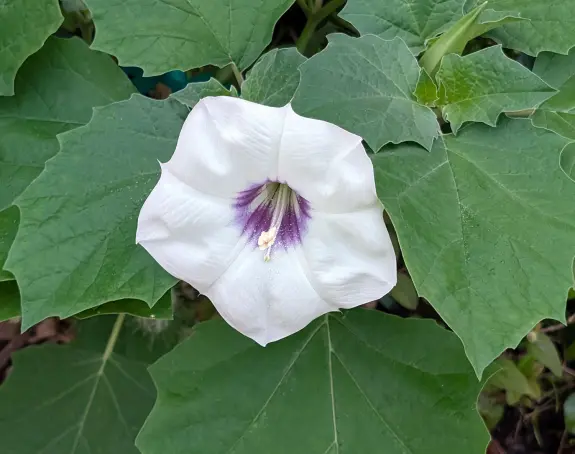
Datura is shrouded in fear. Reports of hell-realms, madness, and trips to the emergency department underlie Datura’s terrifying reputation. Yet, several cultures around the world revere Datura as a powerful folk medicine and a wise teacher. This mysterious herb appears to exist within boundaries. It grows along edges and roadside verges, sits at the precipice of poison and medicine, and is used as a medium for the living to contact the dead and the spirit worlds.
Botanical Classification of Datura
Datura goes by many names: jimsonweed, the devil’s trumpet, thornapple, stinkweed, moonflower, devil’s weed, hell’s bells, and malpitte (meaning mad seeds). It is a genus of flowering plants with nine recorded species, though the name Datura usually refers to a single plant. The plants are vespertine, meaning they blossom at night, and can be distinguished by their white trumpety flowers, alluring scent, and spiky green seed pods.
Datura has highly toxic effects, and there have been numerous cases of poisonings documented over the years. It is a psychoactive plant, and those seeking to “get high”, without proper knowledge of Datura’s effects, have endured perilous repercussions.
Malpitte Madness: Anticholinergic Poisoning and Datura Toxicity
A 1974 report titled ‘Malpitte Madness’ reads, “The use of malpitte or 'mad seeds' (Datura stramonium) by schoolchildren has reached noticeable proportions in South Africa. The abuse of malpitte leads to the problem of an acute psychiatric emergency presenting to the medical practitioner or casualty department.”
And it’s not just recreational users who have faced the effects of Datura poisoning; as a noxious weed, there are several instances whereby individuals and entire groups have mistakenly taken Datura and been severely harmed.
In Iran, a family of six were hospitalised after drinking a “herbal tea” that contained Datura leaves. In Australia, 160 people suffered symptoms of Datura poisoning as a result of the weed contaminating baby spinach grown in a commercial farm in Queensland.
The name “Jimsonweed” traces back to 1676 in Jamestown, Virginia, where British soldiers unknowingly ate Datura stramonium after it was mixed into a salad. The naturalist Robert Beverley documented the incident in his 1705 History and Present State of Virginia. He describes the following scene:
[For] they turn’d natural fools on it for several days: One would blow up a feather in the Air; another would dart straws at it with much furt; and another stark naked was sitting up in a corner, like a monkey, grinning and making mows at them; a fourth would fondly kiss, and paw his companions, and snear in their faces, with a countenance more antick, than any in a dutch droll.
Datura contains compounds called tropane alkaloids that block the chemical messenger acetylcholine. This neurotransmitter helps regulate essential functions in the brain and body, such as controlling heart rate and blood pressure and stimulating muscle contraction.
When acetylcholine is blocked, these functions are disrupted, resulting in extremely unpleasant side effects such as hot, flushed skin, dry mouth, blurred vision, racing heart, rising body temperature, and severe confusion. In some instances, anticholinergic poisoning can be fatal. Medical students are often taught how to recognise the symptoms of cholinergic poisoning with the mnemonic "red as a beet, dry as a bone, blind as a bat, mad as a hatter, hot as a hare, full as a flask."
Datura is classified as a deliriant, which is defined in the medical dictionary as “an agent that alters mental status, causing agitated confusion.” These psychological effects can be explained by acetylcholine’s role in the prefrontal cortex, where it helps control learning, memory, and attention.
Ronald Regan’s Washing Machines: Bizarre Hallucinations and Waking Dreams
One of the key effects of deliriants is true hallucinations – when someone experiences sound, smell, touch, or taste as if it were a real physical thing. These hallucinations possess the exact clarity, force, and quality of everyday sensory input, leading the individual to believe the experience is genuinely happening. In the case of Datura, these hallucinations are often bizarre and, in some instances, frightening.
“I supposedly performed an exorcism on my mom because I thought she was possessed,” recounts an Erowid user who was hospitalised after eating approximately 70 seeds. “Her face kept morphing and bugs were crawling out of her eye sockets. There were also bugs crawling all over the floor of the hospital room as well. My boyfriend's logo on his shirt turned into a bunch of feathers, I saw a little puppy running around the room, and I kept seeing pixies and stars everywhere. Stars kept covering my hands and I had to keep brushing them off.”
In an interview, Alex Thynne, a mosaic artist, recounted having a three-week-long Datura trip, during which he experienced several bizarre hallucinations, moving between dream-like scenarios and reality.
In his first hallucination, he had entered a crystal palace full of jewels, but in reality had face-planted in a jewellery shop. This resulted in him being locked up in a Mexican prison. During his stay, he hallucinated that Nancy and Ronald Regan flew into Oaxaca Square in a helicopter, and handed out an assortment of household appliances to the prison guards.
“I went up to the guards and pointed my finger at them saying ‘I know where you got your washing machines from.’ Everyone was pretty scared of me,” recounted Alex.
During another trip, Alex entered a life-size Barbie rockers tour bus, which he’d earlier gifted a family member as a toy in real life. He described the bus as being rather amazing, with a light-up dance floor, and home to a wise wizard-like figure. The overall experience, however, was frightening. “I really thought I’d lost my mind,” he said.
Datura in Magical Buddhism
While often strange and disorienting, communities across the world have sought out Datura experiences for spiritual purposes. Going back as far as the ancient Greeks, scholars, historians and ethnobotanists have described different tribes and religious groups who have revered Datura as a sacred medicine and magical tool.
In a scholarly article from Portland State University, historian Nicolas Michaud describes how oracles at the temple of Apollo in Delphi may have burned psychoactive plants to help see visions and communicate with the gods. The theory posits that oracles burned species of Henbane, another nightshade plant closely related to Datura. However, Michaud suggests Datura could have been part of the smoke concoction. He notes how psychoactive Datura smoke is still included today in Tibetan Buddhist rituals.
Datura’s association with Buddhism is particularly prevalent within Vajrayāna, an ancient, esoteric school of Buddhism. Practitioners intend not only to bring about spiritual insight but also to influence forces, heal illness and control or appease spirits. In the book Indian Esoteric Buddhism, Professor Ronald Davidson states that Datura was consumed by Vajrayāna yogins in quest to alter their state of consciousness. Datura also appears in over 30 magical spells from Vajrayāna texts, in everything from making someone fall in love to immobilising entire armies.
Datura in the Americas
On the other side of the world, Datura has long been associated with various ritual and religious practices in the Americas.
The Chumash people of California, whose culture is estimated to be over 13000 years old, allegedly used Datura to help establish contact with a supernatural guardian, or dream helper. This mystical being would act as a guardian, providing protection in the supernatural realm, and as a talisman, helping bring good luck. According to anthropologist Richard Applegate, preparations of the Datura were also used as a remedy if someone was unhappy or not doing well in life.
“Datura could show a man his true name,” he writes. “Ignorant of which he could never hope to prosper in this world.”
In the Eastern United States, historian P.D. Newman posits that Datura was used by Native American mound cultures. These societies flourished across the Eastern United States from roughly 800 CE to 1600 CE and developed shamanic traditions centred on the construction and use of monumental earthworks, or “mounds.”
Newman argues that Datura, particularly Datura stramonium, was used to help individuals enter trance states. He references a study in which Datura alkaloids were found in 80% of ceremonial vessels recovered from the Spiro Mounds in Oklahoma.
Finding Lost Treasures
In New Mexico, the Zuni people who still occupy territory today are reported to have used Datura in both folk medicine and divination. A National Park bulletin from 1935 describes how rain priests would use Datura to uncover lost knowledge.
“If one of the Indians has been robbed and wishes to discover the thief, he summons to his aid the rain priest,” the authors write. “The rain priest takes a seat by the side of the man and taking a bit of the Datura root from the palm of his hand places it in the man's mouth, telling him to chew the medicine so that he may sleep soundly and be possessed of the power to see the one who has robbed him.”
Groups in South America have also used Datura for such divinatory purposes. A letter written in 1853 describes how native people of Colombia sought a “second sight” through use of Datura sanguinea, which they called ‘tonga.’ In the correct dosages, it was believed to heighten perception and allow them to discover buried treasures and hidden mines.
Brugmansia, a different plant genus which is extremely similar to Datura, has also been used for divinatory purposes by several tribes in the Amazon. Also known as the “angel’s trumpet” and “toé,” Brugmansia has white flowers that hang downwards and is chemically composed of the same tropane alkaloids.
Anthropologist Glenn Sheppard describes how the Matsigenka tribe use toé to locate lost or stolen objects in an article for Chacruna. He also describes an exceptional experience whereby Datura is used as a last-resort medicine for a tribe member, Henchi, who had become paralysed through injury. After being induced into a three-week-long trance, during which time Henchi met the spirit of Datura, he was able to walk again.
Datura and Ancestral Communication
Both Datura and Brugmansia are used as tools for communicating with the spirit realms. Brugmansia is more closely associated with forest spirits, being used primarily by animist groups in the Amazon, while Datura is more strongly associated with the spirits of the dead. Several Indigenous groups, including the Chumash and Zuni, have used Datura to transcend borders of life and death and communicate with ancestral spirits.
Newman highlights how the shamans of mound cultures underwent a cosmological journey called “the path of souls,” likely involving Datura, whereby one would undergo the same journey a soul goes through once the physical body has died. Applegate also writes about the Chumash, “A person might take Datura to communicate with the spirits of the dead; those who still missed some loved one, particularly a dead child, sometimes took Datura for this reason.”
This theme of ancestor communication also appears in contemporary trip reports, in which people describe meeting dead friends and relatives while tripping on Datura. An Erowid user describes seeing people they’d known who have died and walking and talking with them.
“I smoked bowls and talked of old times with friends and loved ones I thought were forever lost to me. It was truly a life changing experience,” they write. “So complex were the hallucinations that I was really able to view, for one last time, the exact behavior and personalities of people long-dead,” they write. “I hope to all that try it that they have experiences such as mine, and are able, even for a brief time, to enter into this mystical world of spirits and ghosts.”
In South Africa, the traditional healers, or Sangomas, live in close relationship with the ancestral world and consider ancestors as an essential aspect of individual and communal wellbeing. While there’s no documented evidence that Datura is implicated in these ancestral traditions, the plants are known to be part of the medical apothecary of these healers. Furthermore, Datura grows in abundance across the Mautse Valley, a sacred site and spiritual training ground for Sangomas.
Zombie Cucumbers
Datura’s association with death also has an extremely dark side. In Haiti, Datura is known as concombre zombie, meaning zombie cucumber. In Haitian folklore, Datura has long been linked to zombification – the process by which a person is rendered disoriented, amnesiac, and compliant, mirroring the popular image of a zombie. Ethnobotanist Wade Davis documented this practice in his 1985 book The Serpent and the Rainbow, proposing that victims were first dosed with tetrodotoxin, a pufferfish-derived neurotoxin, to induce a paralytic, death-like coma. Once revived, they were allegedly kept in a suggestible, delirious state through repeated doses of Datura.
Datura can render people completely at will of others due to its neurological effects. Acetylcholine is a key component in short-term memory, and blocking it can result in anterograde amnesia, the inability to form new memories. This makes the drug particularly useful for criminals, such that their spiked victims have no idea who robbed them or where it happened.
Datura, Brugmansia, and Crime
In South America, particularly Colombia and Brazil, there’s a huge problem of criminals spiking people with Brugmansia, which is known locally as borrachero (meaning “the drunk maker”). Without mental faculties at play, victims have willingly withdrawn cash from ATMs and moved furniture and goods out of their house to give to burglars. They have been sexually assaulted and woken up with no recollection of what happened.
There have also been scandals of curanderos (folk healers from the Amazon) adding Brugmansia to ayahuasca brews without informing participants. These plants not only make the ayahuasca brew significantly more potent and dangerous, but render participants more vulnerable to manipulation by curanderos. With an ability to navigate different planes of consciousness and reality, curanderos have been accused of performing black magic on inebriated ceremony participants, and Vice have called Brugmansia “the witchcraft plant that’s spoiling ayahuasca tourism.”
Datura as a Witching Herb
Themes of sorcery and witchcraft prevail across much of the Datura literature. In the autobiographical novel The Teachings of Don Juan: A Yaqui Way of Knowledge, author Carlos Castaneda shares tales from an alleged apprenticeship with Don Juan, an Indigenous Yaqui sorcerer from Northern Mexico. In the book, Don Juan teaches Castaneda that Datura is an “ally” which can grant sorcerers powers to tame and use.
Castaneda is taught to use Datura in divination, as well as the experience of body flight. Whether or not he actually flies, or whether Don Juan even existed at all, is unclear. However, the text draws parallels to the flying ointment, a concoction of Datura and other nightshade plants, that has strong evidence of actually existing.
In the 1500s, at the height of the witch-craze, several describe a salve, or lotion, that women would anoint themselves with and fall into a deep sleep. On awakening, they would describe having had realistic journeys of flying. Some would travel to the sabbat, a hidden location in nature where women would gather and engage in feasts, rituals, and sexual freedom. Theories hold that this flying ointment could underlie the legend of witches flying on a broomstick, especially if women were to have first applied the ointment to a wooden structure to be absorbed through the vaginal mucosa.
In a Reddit thread on r/BabyWitch, a community for people new to modern witchcraft, one user asks what kinds of spells can be performed with Datura. In response, other users caution that it should only be used by experienced practitioners, describing the plant as having a strong potential for “dark magick.”
One writes, “Do not use lightly, and if you must use it then approach with the greatest respect. The spirit of Datura is a seducer, and can bring out your worst desires if you leave your heart open to it. It is NOT something I recommend a novice fucking with."
Journeying into the Darkness
This association with dark magic, in the broadest sense of the term, is embedded in the plant’s biology. Datura is sometimes called moonflower because it blossoms at night, often opening in the light of the full moon. It is pollinated by moths, and the potency of its alkaloids, along with its enchanting scent, increases at night.
In Christian thought, dark magic has typically referred to that which is blasphemous, going against the conventions of the church and associated with things like demons and hell. Datura can radically shift someone’s sense of reality, causing them to question belief, and induce hallucinations of otherworldly figures that could be thought of as demonic entities.
In ceremonial magic, black magic is distinguished from white magic as that which is performed for malevolent purposes. Throughout history, Datura has been abused in harmful spells, curses and intentional poisonings. However, dark magic can also refer to practices that work with concepts like the underworld and the shadow. While these darker aspects of existence are taboo and sometimes scary, embracing them can be an essential part of healing.
The famous psychologist Carl Jung coined the term shadow work, meaning the practice of bringing repressed and forgotten aspects of oneself into the light of conscious awareness.
“How can I be substantial if I do not cast a shadow? I must have a dark side also if I am to be whole,” he writes in the 1933 book Modern Man in Search of a Soul.
Bill Plotkin, a more contemporary psychologist, also discusses the underworld as a process of self-transformation. By stepping into the darkness of the mind, he posits one can end old and unhelpful self-images and revive “core soul knowledge.”
Several trip reports describe Datura experiences as entering a hell realm. These are deeply disturbing and often traumatic experiences. However, if one were to journey intentionally in this space of darkness and unknowing, could Datura aid a journey of self-discovery, or greeting the soul?
In their book The Poison Prescriptions, herbalist duo The Seed Sistas describe the feedback from those given subtle amounts of Datura. They write
They often experience a sense of travelling inwards. This contemplation and deep dive into the self can provide space in which to fully discover and explore our inner shadow lands. Datura's connection with the moon speaks of the herb’s ability to illuminate hidden aspects of our selves or spaces that we could perhaps shed light on and feel more comfortable inhabiting… She takes us deep within ourselves in order to draw us out, open up and help us breathe in and accept all versions of ourselves.