
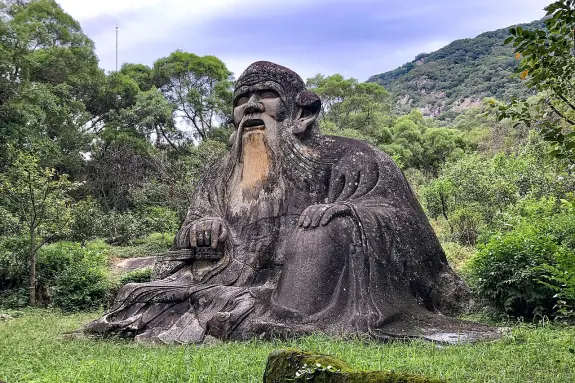
Every time I sit to write about psychedelics, I am confronted with the paradox of talking about the ineffable and splitting the unitive into categories. This meta-awkwardness makes for the first point that psychedelics and Daoism have in common. As Zhuangzi beautifully summarizes it: “Having become one, can we still say anything? Having asserted it is one, can we still not say anything?”
My first encounter with Daoism was through samples of Alan Watts integrated into psychedelic tracks. Next to the voices of Terence McKenna, Timothy Leary, and Eckhart Tolle, Watts is arguably one of the most sampled speakers in psychedelic genres like psytrance and psychill.
Some twenty years later, Daoism and psychedelics constitute significant parts of my life, and have both contributed to shaping my worldview and way of thinking. In this article, I discuss some of their meeting points and how they may shed light on one another.
The Mystical Experience and the Dao
According to Daoism, the Dao (translated as way, path, or doctrine) is the source and fundamental principle of the universe. It is described as undifferentiated (oneness), formless, vast, eternal, and unchanging. All manifested phenomena, like the seasons and living creatures, are subject to transformation; only their source, the Dao, is constant. Thus, the Dao is the oneness preceding the birth of the dualities of yin and yang, heaven and earth.
In the Daodejing, one of Daoism’s foundational texts, Laozi describes the Dao as “all-inclusive”, noting the impossibility of capturing it by words. The Dao cannot be explained or taught, but it can be experienced. Thus, the adept Daoist aspires to tune in with the Dao and align their conduct with it:
The one who knows does not speak; the one who speaks does not know. The wise man shuts his mouth and closes his gates. He softens his sharpness, unravels his tangles, dims his brilliancy, and reckons himself with the mysterious.
One story in the Zhuangzi, another foundational text of the Daoist canon, focuses on an apprentice’s progress in attaining the Way or Dao. First, he forgets socially accepted values; then he forgets the socially appropriate norms and formalities, but this is not enough according to his master. Finally, he describes his latest progress as “I sit and forget”. When the master asks him to explain what he means by that, he answers:
I let my torso and limbs fall away, dismiss my hearing and vision, depart from my physical form and expel knowing, and assimilate to the vast connecting flow.
In today’s psychedelic jargon, the apprentice would say they had an out-of-body experience or that they had experienced ego death. Multiple aspects of being in tune with the Dao resemble descriptions of psychedelic mystical experiences, like the feeling of interconnectedness, becoming one with the cosmos, and losing the subject-object duality.
From America to Europe via Asia
Eastern worldviews and terminology have been part of psychedelic exploration in the West since its beginning. One famous example is The Psychedelic Experience: A Manual Based on The Tibetan Book of the Dead by Ralph Metzner, Timothy Leary, and Richard Alpert from 1964. Yet this connection to Buddhism is far from being the first link to the East.
Literary texts written by 1950s Beat Generation authors, like Alan Ginsberg, Jack Kerouac, and Gary Snyder, already pointed in that direction. These writers were influenced by earlier art and literary figures emphasizing nature and mysticism, like William Blake and Henri-David Thoreau. In turn, they influenced the hippie counterculture and later on the New Age movement.
Published in 1954, a decade before The Psychedelic Experience, Aldous Huxley’s Doors of Perception is perhaps the book that shaped how we view psychedelics in the West most profoundly. When Huxley had his first psychedelic experience, he was already familiar with Eastern philosophies, which helped him make sense of the experience. During that same year, he wrote the introduction to a translation of the ancient Hindu scripture Bhagavad Gita from Sanskrit into English. In 1945, he wrote The Perennial Philosophy, a comparative study of theologies and mystical experiences of Daoist and Buddhist sages, Christian saints, and Muslim mystics.
Another central character binding psychedelics and Chinese thought is psychologist Carl Jung, who wrote the introduction to Richard Wilhelm’s translation of the I-Ching (the pre-Daoist Book of Changes). The I-Ching is a reflection of Chinese cosmology, philosophy, and belief system, and Jung describes his mission as making it accessible to Western minds, using psychology and the notion of the unconscious as a bridge. His psychology is still used in psychedelic therapy.
From Doctrine to Practice
In his book The Easternization of the West, sociologist Colin Campbell describes an evolution of the Western interest in the East. Beginning with interest in goods (from tea to chinaware to judo), it evolved into a fascination with Eastern arts and design. Lastly, in the modern era, comes an interest in Eastern wisdom, and so Eastern ideas and values penetrate the Western psyche.
Campbell also notices a move from an interest in doctrinal ideas to a more “serious commitment”, manifested as a “practical involvement”. In other words, there is a shift from a purely philosophical interest to a practice of spiritual techniques. Taking yoga as an example, he does not rule out that many engage in the practice for “purely secular benefits”, but he describes a change in approach from seeing yoga as a sport to recognizing and valuing its spiritual side.
This shift is in itself Easternization: while Western societies are characterized by a separation of religious and secular aspects of life, for Eastern religions like Daoism, “effectively all of life’s activities are approached as if they possessed a spiritual dimension”. Perhaps psychedelics are going through a similar process.
Mysticism in A Bottle?
With a background as an ordained priest and scholar of psychology of religion, when Alan Watts agreed to participate in an LSD experiment in the 1950s, he was very skeptical. “But lo and behold, I had what I simply could not deny being an experience of cosmic consciousness: the sense of complete, fundamental, total unity forever and ever with the whole universe.” Can a chemically produced trip be considered a genuine mystical experience?
Daoism and psychedelics encounter similar problems as they approach the shores of Western thought. Questions of definition spring up early. Is Daoism a religion? A philosophy? A general approach to life? Are psychedelics medicines? Illegal drugs? Sacraments? We need a definition in order to relate to things and determine our specific approach.
Yet trying to define things is where the problems begin, and this is one of Daoism’s sharpest critiques. By treating an ancient tradition as an object (of investigation) rather than as a living process, we are already missing the mark. If everything is in transformation, what good is a fixed definition? Not only are we trying to fit Daoism (and psychedelics) into a closed box, but it is also a Western one.
Sinologist Nathan Sivin claims that modern historians made the neat distinction between philosophical and religious Daoism, separating the foundational texts of Laozi and Zhuangzi from Daoist practitioners: “alchemists, hygienists, magicians, eclectics, and, in particular, the members of the Taoist church”. As he notes, there is something absurd about treating the canonic texts of a religion as pure philosophy, ignoring their use in religious activity.
Similarly, definitions of psychedelics as spiritual technologies, remedies for mental disorders, or party drugs are all reductionist. We highlight one aspect of a phenomenon as true, correct, or even deem it to be the only one.
Psychedelics can be seen as none and all of the above at the same time. They are all of these things in the sense that they are used by people with all these intentions for all these purposes. They are none in the sense that all of these definitions relate to their practical use. The essence of a mushroom (if there is one) can hardly be defined by the purposes it serves for human beings.
The Path is Made Through Walking
One of the most valuable teachings of Daoism is that “the path is made through walking”. Imagine yourself in a high grass field. Walking in any direction would inevitably create a path, and the more you walk that same route, the clearer and harder the path becomes. This is precisely how habits are created. Walk that path enough times, and before you know it, you take it automatically.
Once a habit is formed, conscious attention and motivation become almost redundant. This mechanism frees up mental space and helps us get around in the world, but it is also involved in creating psychological suffering. Conditions like depression, post-traumatic stress disorder, and addiction are maintained by rigid patterns of thinking, behavior, and beliefs. With his famous analogy of the brain as a snow globe, Robin Carhart-Harris explains that psychedelics are helpful in such cases as they “shake” the snow globe of our brain. As the snow resettles, our engraved paths are gone (or become less distinct), making it possible to choose another path instead of our habitual one.
When Zhuangzi says that “a path is made by walking it, things are so by saying they are so”, he means it in a more radical way. The context of this quote is a discussion about the relativity and temporality of values, statements, and perceptions, and the effect that our beliefs have on our reality. In the same way that repeating to yourself that you are incapable renders you incapable, socially established beliefs determine how we experience the world.
Indeed, psychedelic experiences are highly influenced by our personal and cultural context, including, for example, our culture’s beliefs about visions, madness, health, and supernatural phenomena. In early psychedelic experiments with indigenous and Western participants, only the Westerners felt they were going mad. This was the case because Western culture associates hallucinations with madness. In other words, “things are so because we say they are so”.
The Problem of Knowledge
Daoism highlights our limited perspective, the partiality of learned knowledge, and our inability to comprehend the bigger picture:
You can't discuss the ocean with a well frog - he's limited by the space he lives in. You can't discuss ice with a summer insect - he's bound to a single season. You can't discuss the Way with a cramped scholar - he's shackled by his doctrines. (Zhuangzi)
Zhuangzi lived during the Warring States period, a time of social, economic, and political turmoil in China, which seems to resemble our current global reality. He describes a dull and uninspiring leadership, great polarization, and scholars who compete for the superiority of their theories:
Everywhere under Heaven is in great disarray, the worthy ones and the sages have no light to shed, the Tao and Virtue are no longer united, and the whole world tends to see one aspect and think that they have grasped the whole of it. They can be compared to the ear, the eye, the nose and the mouth. Each has its own light to shed but you cannot interchange their functions. Likewise, the hundred schools of philosophy have their points and each has its time of usefulness. Though this is true, nevertheless not one of them covers the whole truth…
Abstract conceptual thought slices reality into separate parts, biased by our beliefs, tastes, conventions, and desires. Thus, rather than insisting on learning, Daoism promotes the forgetting of knowledge. Likewise, psychedelic trips can disrupt our sense of knowledge and bring about crises and insights related to the crushing of our previous assumptions about the world and ourselves.
Psychedelic research in the West is situated within a secular and materialist worldview (preconceived knowledge). Like in the case of separating Daoist philosophy from religion, many scholars try to separate what they consider “psychedelic science” from the mystical and “the woo-woo”. The conceptualization of psychedelics as molecules, and of visions as hallucinations created by the brain, helps us keep our materialist worldview intact.
As with Campbell’s example of yoga, we adopt the indigenous-made ayahuasca brew, discarding the animist worldview out of which it was born. Similarly, Daoist ideas about immortals, spirits, and a celestial bureaucracy were dismissed by scholars as “vulgar beliefs” and “folkways”, and the I-Ching was disposed of as a collection of “magic spells”.
In his foreword to the I-Ching, Jung admits that he wouldn’t have dared to express himself “so explicitly about so uncertain a matter” before. What allowed him to take the risk is that he was now in his “eighth decade, and the changing opinions of men scarcely impress me any more; the thoughts of the old masters are of greater value to me than the philosophical prejudice of the Western mind.”
This uncertainty, or the forgetting of knowledge as Daoists call it, is highly appreciated in Daoism. In fact, according to Laozi, convictions are the main obstacle to a union with the Dao: “Even if one has but a little knowledge he can walk in the ways of the great Tao; it is only self-assertion that one need fear.” In the face of uncertainty, people tend to cling to their old convictions or quickly establish new ones. The Daoist advice is not to “solve” the uncertainty, but to accept your ignorance and relative point of view. As Laozi says, “To know that you do not know is the best.”
There is No Right Path
Philosophers who “know” the correct path, highlighting certain values and behaviors as right or wrong, are sharply criticized by Zhuangzi. Not only does Daoism reject the notion of one correct path, but it also blames them for confusing people with their false ideas.
Daoism encourages one to act out of their own spontaneous nature, what is “self-so” (Ziran), rather than according to established ideals and social conventions. In this regard, it stands much closer to countercultural and underground approaches to psychedelics than to that of therapeutic or wellness applications.
Zhuangzi’s heroes are often physically disabled and disfigured. He insists that being considered flawed and useless by society may actually render one’s life longer, for example, by not being recruited to the army. On a moral plane, he rejects socially accepted norms, presenting characters with chopped feet (an ancient form of judicial punishment) as wise men to learn from.
From the Three Dynasties on down, everyone in the world has exchanged their inherent nature for things. Commoners sacrifice themselves for profit; officials sacrifice themselves for reputation; ministers sacrifice themselves for their clan; sages sacrifice themselves for the world.
For Zhuangzi, rather than a standard, conduct is a result, an outer manifestation of an inner union with the Dao. If he lived today (and I’m obviously widely speculating here), he would probably reject the psychiatric idea(l) of normality and the labeling of mental disorders in the first place. Looking at the trillions-of-dollars wellness industry, he would reject the logic of constant and endless investment in the unattainable goal of improving oneself.
Behind such applications lies an underlying assumption of an ideal behavior, personality, or approach to life – something to aspire to. For Zhuangzi, this would be the opposite of Ziran, what is so of itself, naturally and spontaneously. In the above quote, he criticizes people of all social classes for sacrificing their divine and spontaneous nature for earthly things and values like money, reputation, and even what we call “noble causes”.
The understanding of Eastern traditions as personal spirituality or psychology is probably a modern Western twist. Far from self-help books or personal guides for spiritual transcendence, the classical Daoist texts deal with metaphysics, social, and political life, and include instructions for royalty and governors on how to lead the people and the country in line with the Dao.
Obviously, not all kings had mystical experiences to inspire them. But even if they did, the masters were very much aware of the gap between altered and normal (waking) states of consciousness, and how easy it is to fall into the old patterns and perceptions once the altered state has passed. In this sense, the old books function more like integration guides than tripping manuals.
Did Daoists Use Psychedelics?
We know of plant and substance use for mystical revelations and other religious purposes throughout history. Ayahuasca use is documented in Meso- and South America, the use of Fly Agaric in Siberia, the mysterious Soma drink mentioned in the Indian Rigveda text, and the Kykeon of the Eleusinian Mysteries.
At the same time, hard evidence for substance use from thousands of years ago is hard to find. This was the subject of a talk by Manvir Singh, one of the key speakers at ICPR 2026. Contrary to our convictions, reliable evidence of traditional use of ayahuasca and Peyote was found only in limited areas. Moreover, evidence shows that traditional use, whether in America, Europe, or Africa, was not limited to healing and spirituality, as it is commonly presented. In different cultures, psychedelics were (and are) used for various purposes, like recreation, locating lost objects, or communicating with spirits and non-human beings.
Taking this into account, we can reflect on Daoist substance use. We know that early Daoists mingled with Fangshi (“formula masters”), and that Daoists used “external alchemy” (Waidan), including experiments in creating an immortality elixir, which, according to modern medicine, had significant hallucinogenic effects. This practice was halted after some of these experiments ironically led to the death of drinkers.
Laozi and Zhuangzi do not mention the use of psychoactive substances in their texts. They do refer vaguely to what looks like meditation practice, and specific techniques are assumed to have been taught orally from master to disciple.
Zhuangzi does critique some physical practices, probably Daoyin or Qigong, aiming at achieving longevity. While he clearly preferred sitting meditation, according to sinologist Woei-Lien Chong, the criticism is less against the methods and more against the goal of prolonging life. Indeed, the title of the relevant chapter is “forced intentions”. In Zhuangzi’s view, every living creature is granted a certain number of years, and the idea is to live it according to the Dao, not to try to prolong it indefinitely.
Interestingly, we see the same kind of phenomenon in the psychedelic field. On the one hand, psychedelics are seen as a means of coming to terms with death; on the other, more and more psychedelic research is looking into longevity. This approach, which culminated in longevity entrepreneur Bryan Johnson’s livestreamed trip, was highly criticized within the psychedelic community.
According to Daoism researcher Qiongke Geng, use of psychoactive substances in Daoism can be traced back to Wu‑shamans during the Shang period, the second Chinese dynasty. Later texts include instructions for secretive breathwork techniques, diet, proper harvesting and cultivation, and the preparation of hallucinogenic compounds.
One such example is the Daoist book Notes Kept Inside the Pillow from the Tang dynasty era. It describes specific doses, processing methods, and ingestion instructions for daily consumption of pills made from Poria cocos mushroom. Its medicinal value was already known in Chinese medicine, but the author describes a process in which the physical benefits evolve into spiritual ones:
Continuous use for one hundred days will eliminate all ailments; after two hundred days, the ability to see in darkness will be attained; after two years, one will gain power to command spirits; and after four years, a jade maiden will come to serve.
As Geng explains, effects are described in a progressive development “from physical healing to divine communion”, from pharmacological effects to mystical experiences. Here again we face a major conflict between Eastern and Western metaphysical perceptions, as the description completely violates the Western mind-body divide.
Reminiscent of indigenous practice, Geng points to a ritualistic regulation of hallucinogenic consumption. There are rules for sourcing, preparation, and administration of what is considered a “sacred formula”, such as a three-day purification fast and abstinence from sexual activity. Confidentiality and transmission of knowledge are assured through strict rules, guarded by worldly and posthumous punishments.
Considering this secrecy, we may never find out if early Daoists in fact used psychoactive substances. Perhaps it is best to forget about it and simply “assimilate to the vast connecting flow”.
Thank you to the members of my Daoist book club for the constant enrichment of my understanding.