

Introduction
We are what we repeatedly do. Excellence, then, is a habit, not an act.
—Aristotle
What if the foundation of a transformed life was not a single moment, but the cumulative effect of daily habits?We live in a culture that often glorifies overnight success and instant results, so it can seem counterintuitive that the path to meaningful change is not found in a single dramatic breakthrough, but in a slow, steady climb of daily improvement. This is especially true in the psychedelic realm, where stories of overnight transformation abound.
But those of us who have been in the psychedelic integration game for a while have come to understand that the massive positive changes are not always easily embedded long term. Even with the richest, most profound, and startlingly clear insights. This is why the importance of psychedelic integration—the process of embedding the insights into how we show up day in and day out, including our habits— has been emphasised more and more over the last few years.
In his groundbreaking book Atomic Habits, James Clear sheds light on the science of habit formation and reveals how small, incremental changes can compound over time to produce remarkable outcomes. When we combine the transformative potential of psychedelics into this framework, we gain the tools to not only change our habits but also reshape our very identity.
But how? What role does habit formation have in psychedelic integration? Do they synergise? And if so, how?
Fear not, I will be answering these questions and more in this two part series of habit formation and psychedelic integration on the Chemical Collective Blog.
In this article, part one, I will be looking at some of the biggest ideas from Clear’s book, from “the 1% principle” to how our beliefs shape our habits. I will then look at how insights from psychedelic experiences might be leveraged to support a reshaping of our identity and in turn our habits, and how psychedelics’ effect on the brain can support habit formation.Introducing James Clear and Atomic Habits
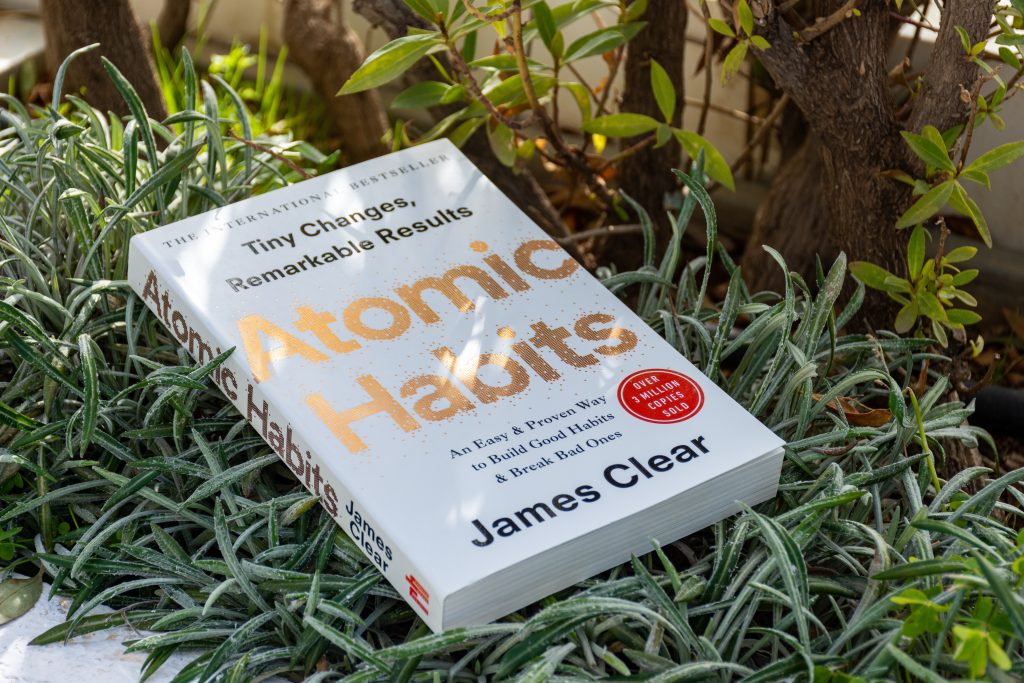
One of the best-selling self-improvement books of the last few years is Atomic Habits by James Clear. A #1 New York Times bestseller, it has sold over 20 million copies worldwide and has been translated into more than 60 languages. In his book, Clear delves into the science and psychology of habit formation, and teaches readers how to build good habits and break bad ones.
Before we get into how psychedelics fit into the equation, let us take a quick look at three big ideas from the Atomic Habits.
-
Small Actions Can Make a Big Difference
In what he terms as the “1% principle”, Clear explains that if you get just 1% better every day at something, after just one year, you are 37 times better! On the other hand, if you get just 1% worse every day for a year, your level goes down 96%, almost down to zero.
This illustrates the power of those small actions which are done consistently (including daily habit) and how they can lead to exponential growth or exponential decay.
-
Systems Over Goals
"You do not rise to the level of your goals, but fall to the level of your systems."- James Clear
Another key point that Clear emphasises in Atomic Habits is that systems should be prioritised over goals. For example, if someone has an aim to lose weight and get in good physical shape, that is a goal. But if someone has a system of going to the gym three times a week and eating healthily, it is the system, rather than the goal, that will get them their results. Of course, goals can be useful in deciding what systems to implement, but systems are what ultimately move us forward over the long term.
-
Identity-Based Habits
For example, if we believe we are not someone who exercises regularly or we do not see ourselves as an active person, our actions align with that belief more often than not. In this case, not being active. Our actions are a reflection of our beliefs and as such our beliefs can become self-fulfilling prophecies.
Clear suggests first changing our view of ourselves—our identity. Next, we should prove this new identity to ourselves with small wins.
For example, if you want to eat healthily, you need to believe that you are a healthy eater. So you would begin by telling yourself that you are, or can be, a healthy eater. You would then prove this new identity to yourself with a small win. For example, you eat an apple. This new identity of a healthy eater has just been supported by this small action. This small win can then help to continue making decisions and actions that align with the new identity, which can grow and strengthen with time, further reinforcing your habits and the type of person you are.
Psychedelics and Subconscious Beliefs

Psychedelics come into play here because they may reveal subconscious beliefs about ourselves. These may be 'limiting beliefs', a term for the things we believe about ourselves that limit our potential in some way.
For example, if I believe on some level (be it conscious or subconscious) that I am not very good at cooking, that belief can affect my actions. I might not make much effort to cook a nice meal because I might think, "Well, what's the point? I'm not good at cooking anyway." Or, it might prevent me from trying to learn a new recipe. Essentially, it will make me behave in a way that fulfils that belief. This belief limits my potential to be confident and competent in the kitchen, and so would be an example of a limiting belief.
Psychedelics can be useful in this regard because one of the psychological mechanisms that they can trigger is bringing unconscious material to the conscious mind. This includes beliefs. So, to use the example above, I might realise in a psychedelic session that actually, deep down, somehow I have this belief that I am not incompetent in the kitchen. If I discover this belief about myself during a session, it is a chance to change it. I could lean into challenging it and shaping a new belief about myself. This new belief about myself might be “I can make tasty food”. I would then begin to prove this new identity to myself with small wins, for example, putting together a simple but delicious snack.
This can be applied to any beliefs about ourselves that we may discover in a psychedelic session and can become an opportunity to reshape our beliefs and identity, our habits, and ultimately who we are. This process of growing and reshaping ourselves then becomes part of our psychedelic integration.
Insights and Inner Healing Wisdom
Neurogenesis, Neuroplasticity, and Psychedelic Support
Piecing it Together and a System for Psychedelic Integration

Psychedelics offer us an opportunity to discover beliefs about ourselves and unearth insights which can act as north stars in psychedelic integration. This coupled with their ability to support the brain in changing and adapting via neurogenesis and neuroplasticity holds great potential to implement the learnings and lessons on habit formation that Clear shares in Atomic Habits.
But, if you remember, Clear emphasises systems over goals. This begs the question:‘How do I create a system to support my goals and implement my insights?’
Well, in Atomic Habits, Clear also lays out the ‘four laws of behaviour change’. These are based on what he has identified as the four pieces of a 'habit loop’, and can be used to create those very systems which will then guide and support you in creating new habits you would like to adopt, and in letting go of those you would like to drop.
These four laws can be a highly useful framework to use in the integration of rich psychedelic experiences that reveal unconscious beliefs or personal insights. We will cover them all and how they apply to the integration process in the next part of this two-part series on the Chemical Collective blog.
But, before then, I’d like to finish this post with a few prompts you can use to help uncover beliefs about yourself, even without a psychedelic(!).