
Through an error of calculation, I swallowed six times what is for me a sufficient dose. I was not aware of it at once. Eyes closed, I watched in myself, as on a screen or a ship’s log, the colors and the lines, this time gigantic, of Mescaline appearing in my inner vision, and the agitation of the images, always so amazing. Then suddenly, nothing any longer. I saw nothing. I had slipped down to some bottom. A door, open till now, had suddenly closed in absolute silence.
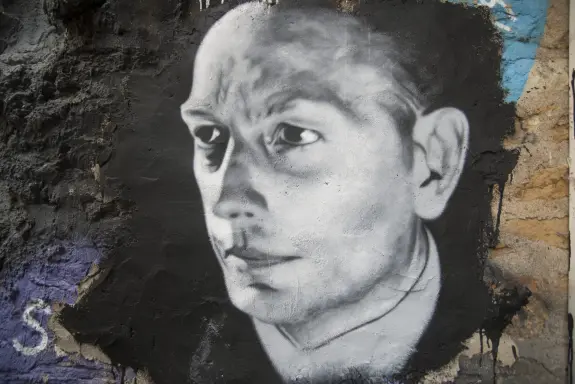
The experimental poet, writer, painter and lesser-known psychedelic explorer Henri Michaux sits quite at odds with the archetypical image of the mid-20th-century psychonaut. We might think of Aldous Huxley flinging wide in The Doors of Perception, fascinated by the divine and the “labyrinth of endlessly significant complexity” in his flannel trousers, for example. Or, Timothy Leary proselytising for us to “turn on, tune in, drop out”. For figures such as these, the psychedelic realm was seen as a promised land, a source of spiritual and societal liberation. Michaux stands out as profoundly different. Far from an active seeker of utopia or in search of messianic visions, he explored psychedelics as a reluctant, sober, and deeply sceptical investigator.
Born in Namur, Belgium, in 1899, Henri Michaux was already a known figure in art and literature prior to his psychedelic encounters. His work explored his own inner landscapes, and he was celebrated for his introspective poetry:
“In the night In the night I united with the night To the limitless night At night”
- Henri Michaux, Dans La Nuit
And for his pen drawings, which blurred the line between writing and image.
In 1954, as part of an experiment prompted by his publisher, Michaux tried mescaline for the first time, a psychedelic compound derived from the Mexican Peyote cactus. Though he was already 55 years old and a firmly established pillar of the artistic community, the experience transformed his life and future work. Over the next decade, the otherwise habitually sober Michaux wrote several books on his psychedelic experiences, which included dozens of vivid drawings.
Michaux was an artist who was, from an early age, interested in the relationship between drawing and writing – a master of the use of both line and language to transmit ideas. Mescaline would expose him to a state which could annihilate both of these abilities entirely. In his own words, translated in The Paris Review:
What immediately interested me…was the rapport between the image and the idea, between the wish to see something and what one sees. In mescaline one finds an independent consciousness…its own world of images. One learns what it is both to have and not have a will.
Miserable Miracle
This book is an exploration. By means of words, signs, drawings. Mescaline, the subject explored.
The original text [was] more tangible than legible, drawn rather than written…flung onto and across the paper…interrupted sentences, with syllables, flying off, frayed, petering out. Their tattered remnants would revive, bolt, and burst again. The letters ended in smoke or disappeared...their wings cut in flight by invisible scissors.
His first overwhelming discovery was what he described as “insurmountable difficulties” stemming from the “incredible rapidity of the apparition, transformation, and disappearance of the visions.” The mescaline experience was defined by this seemingly unending velocity. He felt he was “swept headlong without ever turning back [at] unendurable speed.” This was torturous for an artist whose work was defined by careful contemplation. The “intolerable haste” he felt within rendered his usual artistic toolset utterly useless. How could he coherently explain a thought when it was immediately replaced by a thousand others? The unbridled speed, he felt, was not a creative energy, but a destructive force which demonstrated his utter powerlessness.
Flowing directly from this “unendurable speed” was his next realisation – a profound alteration of the self, itself. Psychedelic literature is rich with descriptions of “ego death”, typically seen as a transcendent dissolution into a greater whole. Not so for Henri Michaux. He did not gently dissolve; he was shattered and torn apart. He described a state in which his “calm was violated a thousand times by tongues of infinity,” concluding that “the thousands upon thousands of rustlings were my own thousand shattering.” He felt an initial disconnect within himself, where he was forced to “watch like a stranger” his own seemingly mechanical movements. During the most intense period of the experience, he was no longer even a person in control at all but something “caught, not by anything human, but a frenzied mechanical agitator, a kneeder-crusher-crumbler, treated like metal in a steel mill”.
This was far from a spiritual union; he felt nothing but alienation from himself, the self, split apart against his will. This sets Michaux further apart from his contemporaries. In his attempt to relate his experiences as an observer, free of bias, he discovers an innate inability to do so. Post-war art and philosophy had reflected the idea of the self as free and responsible for its thoughts and actions. As a result of his mescaline experiences, Michaux now saw that this unified “self” was in fact a comforting fiction – a fragile and temporary construct.
Michaux’s third discovery concerned the fundamental nature of reality itself. When the initial onslaught of fractured images subsided, it was replaced by a universe now shorn of all meaning. Michaux watched reality melt away into a world of “unemotional character” and “mechanical appearance.” This was a world of unthinking movement alone, where “enormous plowshares plow without any reason for plowing.” Endless movement without meaning, where he was subject to the “torture of what is unstable…what is impermanent.” Once again, Michaux stands apart from his contemporaries; he did not join figures like Huxley in a divine, spiritual dimension. He was “caught and held prisoner in some workshop of the brain.”
This was the crux of it all. The true “misery” of the miracle. The realisation that beneath the realm of human perception lies this abyss of meaninglessness. Endless, undulating energy. It was this “prodigious vibration, multiple, delicate, polymorphous, appalling,” that he would attempt to draw to create a direct record of the experience, which words could not explain.