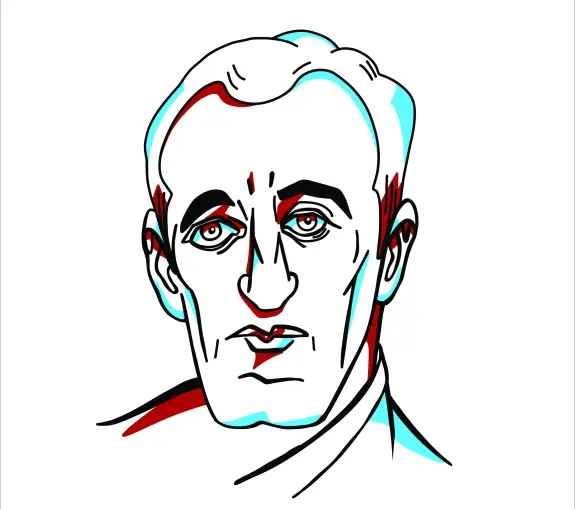
My body is the fabric into which all objects are woven, and it is, at least in relation to the perceived world, the general instrument of my ‘comprehension.’
While his existentialist contemporaries were busy wrestling with the concepts of ‘being’ and ‘nothingness’, the French philosopher Maurice Merleau-Ponty was developing a radical new form of philosophical thought, quite divorced from their thinking. While the intellectual circles of mid-century Paris were stuck in abstractions, Merleau-Ponty’s philosophy was purposefully more grounded – an attempt to return to the raw, visceral experience of the reality of actual lived reality. At the core of his work was the concept of the “lived body”.
In his most well-known text, Phenomenology of Perception (1945), the “lived body” is explained in terms of the individual, the “embodied subject”. For the first time in the history of modern Western philosophy, the body was itself conceived of as a subject. This went completely against the centuries-old idea of an ephemeral mind inhabiting a body, rather than just an element of it. For Merleau-Ponty, the body is not simply an object to possess and harness; it is at the very centre of our individual worlds. He unified the body and mind as a whole, returning his philosophical focus to carnal, sensory experience. Drawing from the earlier work of Edmund Husserl, he and his contemporaries described this as the philosophy of “phenomenology”.
Interestingly, Merleau-Ponty’s focus on direct experience, albeit unintentionally, makes his philosophy perfect for investigating states of consciousness that dismantle the self itself. Similar to his contemporary, Jean-Paul Sartre, who we previously discussed on the Chemical Collective blog, Merleau-Ponty even submitted his consciousness to a clinical mescaline experiment. Similarly to Sartre, again, Merleau-Ponty did not fall through a portal to another world or commune with gods or spirits. Rather, he found powerful confirmation of the totally intertwined, fluid nature of reality as a whole, which he had spent his life up to that point investigating. His entire philosophical discourse, it turned out, was the perfect sober preparation for aiding his understanding of the truths that psychedelics reveal in such powerful, often distorted, and challenging ways. So, prior to exploring Merleau-Ponty’s discussion of hallucinations and the psychedelic experience, and applying his philosophical viewpoint to it, let’s step back and first define phenomenology itself in a bit more depth.
What is Phenomenology?
Psychedelics and Phenomenology
Like a number of his existentialist contemporaries, Merleau-Ponty’s philosophical insights were not confined solely to quiet contemplation and rigorous, sober study. On at least one occasion, he self-experimented with psychedelic compounds as a means to deepen his experience of direct experience itself. This psychedelic experimentation, interestingly, was not some sort of countercultural movement at the time. As with the vast majority of the first wave of research into psychedelics in the mid-20th century, it was still sober and scientific in terms of its curiosity and method of ingestion. This was long before these substances became associated with cultural rebellion or rejection (ironically, not seen “as the things themselves”). The psychedelic simply allowed for the philosopher to witness the very foundations of his embodied perception as they begin to warp and dissolve – in theory allowing him greater insight into its construction.
While Ponty did not undergo quite as intense a mescaline experience as Sartre, he still found it philosophically useful. He used his observations from the experience to actively critique the scientific method’s approach to understanding hallucinations at the time. Merleau-Ponty posited that the current dogma struggled to explain the difference between hallucination and reality by positioning them solely as events occurring in the brain. He said, “When the victim of hallucination declares that he sees and hears, we are in no position to contradict him, but it is also the case that “we must not believe him.”
Merleau-Ponty offered a very different interpretation, which was not centred around solely activity inside the brain, but in the person’s relationship to the wider world around them. He argued that all hallucinations, regardless of cause, initially relate to the body as a physical product of the senses. As Mike Jay writes in an article for The Paris Review, quoting Merleau-Ponty:
“The phenomena are not purely intellectual: All hallucination bears initially on one’s own body,” as a physical product of the senses. A hallucination is presented to the observer alone, and “the normal person does not find satisfaction in subjectivity … he is genuinely concerned with being in the world.”
Because a hallucination is only visible to the individual experiencing it, it highlights how ‘normal’ consciousness is not, in fact, a private mental activity. Mescaline’s ability to create vivid hallucinations provides the means to actively experience how perception and consciousness are fundamentally embodied and social in nature. When forcibly divorced from these notions, the individual returns to a solely “embodied” state, shorn of all associations outside of the moment of experience.
Merleau-Ponty was able to learn from these experiences when viewed through the lens of his philosophy, developing a structure to the phenomenology of perception.
Here are some of the things that Merleau-Ponty experienced on mescaline, as described in Phenomenology of Perception, as well as his interpretation of those experiences:
Under mescalin it happens that approaching objects appear to grow smaller. A limb or other part of the body, the hand, mouth or tongue seems enormous, and the rest of the body is felt as a mere appendage to it. The walls of the room are 150 yards apart, and beyond the walls is merely an empty vastness. The stretched-out hand is as high as the wall […].
[…] certain parts of the body are enlarged out of all proportion, and adjacent objects made too small because the whole picture no longer forms a system. […] if the world is atomized or dislocated, this is because one’s own body has ceased to be a knowing body, and has ceased to draw together all objects in its one grip […]
The influence of mescalin, by weakening the attitude of impartiality and surrendering the subject to his vitality, should favour therefore forms of synaesthetic experience. And indeed, under mescalin, the sound of a flute gives a bluish-green colour, the tick of a metronome, in darkness, is translated as grey patches, the spatial intervals between them corresponding to the intervals of time between the ticks, the size of the patch to the loudness of the tick, and its height to the pitch of the sound.
Regarding the synaesthesia described above, Merleau-Ponty offered the following explanation in Sense and non-sense (1964):
For people under mescaline, sounds are regularly accompanied by spots of color whose hue, form, and vividness vary with the tonal quality, intensity, and pitch of the sounds. […] My perception is therefore not a sum of visual, tactile, and audible givens: I perceive in a total way with my whole being: I grasp a unique structure of the thing, a unique way of being, which speaks to all my senses at once.
Phenomenology of Hallucinations
Merleau-Ponty argues that hallucinations are far from faulty sensations, ideas, or beliefs. Instead, he views them as the result of two separate elements of perception malfunctioning.
First, there is “the power of summoning”, which is the body’s sober ability to structure the world around us coherently, in response to the cues the world provides. This shows how the individual perceives the world as having an immediate bodily significance. For example, rather than experiencing a completely neutral environment of things, the individual perceives things as:
having a value [in terms of our] capacities to interact with them…Chairs as for-sitting, cakes as edible, hollow trees as for-hiding-in, scorpions as to-be-avoided, and so on.
These inherent associations are what Merleau-Ponty describes as being “summoned” by our embodied experience of the world. In a hallucination, when these associations are no longer linked, the summoning power “runs wild”, creating an artificial world, or even worlds, and sensory or sensory-like experiences without any actual prompting from real, external reality.
Second, there is “perceptual faith”, which is not actually a conscious belief, but rather the fundamental feeling that the world/body we inhabit is real. When this implicit faith is disrupted, for example, by a substance like mescaline, “the perceived world loses the value of reality, whilst hallucinated entities gain it.”
Merleau-Ponty described this as “hallucinatory deception”. When the hallucination gains this “value of reality”, it feels intrinsically real. There is, however, a core difference between the experience of hallucinations and that of normality. A real object is perceived as “inexhaustible”, meaning it possesses infinite horizons – its known appearance from other angles, finer details, the structure within and without, countless other possible viewpoints, from other people. Importantly, these infinite horizons are public and visible to all. It is the depth of the object, outside of solely the object itself, which places it in a shared world.
For Merleau-Ponty, hallucinations lack this level of depth or structure and are fundamentally ephemeral and divorced from normality. Therefore, they are solely private experiences for an individual alone. This isn’t necessarily a judgement the individual makes about this experience after the fact; it is the felt quality of the experience itself in the moment, completely splitting it off from collective consciousness as a whole.
Why Merleau-Ponty Matters Today