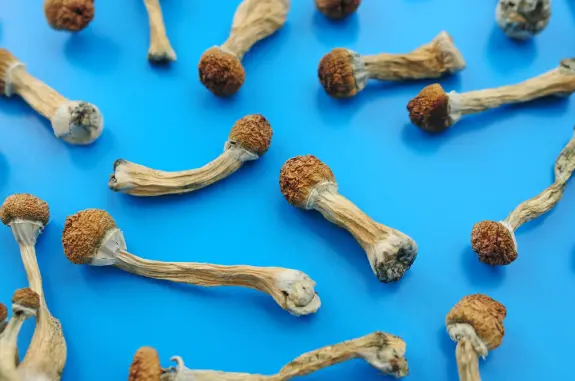
The striking imagery of blue honey is unlike any other kind of psychedelic preparation – the staining of the honey by the natural degradation of psilocybin (along with other compounds) contained in magic mushrooms provides an enticing aesthetic when it comes to inventive ways of preserving psychedelic fungi.
This kind of alchemy, which can be performed in your kitchen, opens up a new arena to combine the sweetness of honey with the potency of magic mushrooms. You might think you were stumbling upon some kind of historical artefact or elixir from thousands of years ago if you were to discover a jar of blue honey in your friend's cupboard, but this is something which can be made very easily at home.
The first time I ever chopped up fresh Psilocybe cubensis mushrooms, I was startled by the blue bruising and found myself drawn to this visible transformation. I was aware that the bruising indicated the presence of the compound psilocybin, and this confirmation felt exciting and almost celebratory. This feeling of being drawn to the colour change might also indicate a wider general affinity within different human cultures for things such as fermented foods (which can create meaningful relationships between humans, microbes, and transformation), as well as providing a visual stimulus to energetically charge the mushroom within a meaningful context of material transformation. This might also provide more of a sense of authenticity and sacredness of the experience, where we can see something powerful happening.
For any fans of the sci-fi epic Dune (a media franchise which originated with the 1965 novel by Frank Herbert and later turned into subsequent movies), blue honey might be reminiscent of the ‘Water of Life’ – a substance used by a powerful spiritual, social, and political force known as the “Bene Gesserit”. This poisonous substance is extracted from the bile of young sandworms, which inhabit Arrakis – the fictional desert planet at the centre of Herbert’s series. (The planet is the only source of the psychedelic drug melange, also referred to as “the spice”, which is the most valuable commodity in the universe, allowing consumers powers of prescience, along with greater vitality, longer life span, and heightened awareness)
The Water of Life is used in a ritual known as the “Spice Agony”, where a Bene Gesserit initiate is able to survive the ordeal and convert the narcotic in their body to unlock genetic memory. One who has achieved this is referred to as a “Reverend Mother”, where gaining genetic memory of all her female ancestors results in a sudden and immense accumulation of knowledge and abilities. This ritual could be reminiscent of experiences with psychedelic substances, where participants might undergo ‘ego death’, where there is a sense of spiritual death and rebirth.
This doesn’t seem like a coincidence, as the mycologist Paul Stamets revealed in his book Mycelium Running, with Frank Herbert stating the influence that magic mushrooms had on his Dune series:
Frank went on to tell me that much of the premise of Dune—the magic spice (spores) that allowed the bending of space (tripping), the giant sand worms (maggots digesting mushrooms), the eyes of the Fremen - [the native population of Arakkis] (the cerulean blue of Psilocybe mushrooms), the mysticism of the female spiritual warriors, the Bene Gesserits (influenced by the tales of Maria Sabina and the sacred mushroom cults of Mexico)—came from his perception of the fungal life cycle, and his imagination was stimulated through his experiences with the use of magic mushrooms.
This kind of imagery lends itself to an aesthetic fascination with psychedelics within a ritualised context, and the presence of blue honey would certainly add a charged element to these kinds of experiences. But what about honey itself, and how does it feature within a wider story of preserving different medicines?
Honey, Preservation, and Ancient Medicines
What excites me personally about blue honey is my fascination with honey itself, being a food which finds itself placed within a much older chapter in human history. Honey has a seemingly timeless value, with prehistoric humans having collected honey and beeswax for around 9000 years, both for medicines and food.
In Ancient Egypt, bees were associated with royalty and honey itself was used for thousands of years for sweetening foods, healing wounds, paying taxes, and embalming dead bodies. The spiritual association with honey has its foundations in the belief that bees are of divine origin, and the honey represents the tears of the sun God Ra.
Similar to this mythology, the Ancient Greeks revered honey as a source of wisdom, poetry, and unbelievable powers, with bees being seen as messengers of God. The father of modern medicine, Hippocrates, was a big advocate of the healing properties of honey and prescribed it to treat wounds, reduce inflammation, and support digestion. The high biodiversity of a country such as Greece meant that the kind of honey consumed was often made from the nectar of wild medicinal plants like thyme, sage, and oregano. Bees collect nectar from these herbs, infusing their honey with natural plant compounds called polyphenols – the same antioxidants we now associate with superfoods.
Herbs themselves have featured consistently in traditional folk preparations made with honey, with the honey being consumed to treat various diseases after being infused with different herbs, including cardiovascular diseases, cancer prevention, digestive disorders, immune system support, and allergy prevention. In Ayurveda, honey is regarded as an elixir of good health, which can balance out the various energies in the body, as well as assist with digestion, respiratory health, boost the immune system, support energy, skin health, and good sleep.
Ayurveda also speaks of honey as having a calming effect on the mind, with the sweetness and warming qualities having a positive impact on mood. Contemporary research seems to support this, showing that honey can, in fact, provide memory-boosting effects, neuroprotection, and pain relief. (As a self-confessed honey fanatic, I wonder if perhaps my obsession hasn’t just been down to enjoying the sweet taste, but also my body knowing what I should be consuming to best support itself!)
In Ancient Rome, the relationship between humans and honey was imported from the Greeks and expanded across the Roman Empire. Early culinary texts such as Apicius describe its uses in savoury sauces for meat, wine, and pastries, with the Romans understanding how its complex sugars add depth and variety to dishes. The 1st Century beekeeping manual, Columella's De Re Rustica, contains practices which are similar to today's beekeeping, such as moving hives to certain areas to take advantage of particular flowering seasons.
Honey was also used extensively in Rome as a preservative, with its ability to draw moisture out of surrounding materials making it useful for storing fruit. Fruit stored in this way would supposedly be edible for impressive periods of time, with honey itself still being edible 3000 years later from places such as Egypt (and even 5000 years from honey found in Georgia!).
This historical use of honey as a food, medicine, and preservative lends itself to a wider human story of preserving substances associated with vitality, intoxication, healing, and transcendence. Blue honey might seem like something of a psychedelic novelty, and just a gimmick to create an exciting-looking substance which feels more magical than simply consuming the mushrooms themselves. But if we connect with the historical consumption of honey, we can see how the infusion of psychedelic mushrooms into honey might be continuing a lineage of preservation instincts, linked to ideas surrounding fermentation, herbal medicine, and the historical preparation of different psychoactive substances.
With increasing conversation surrounding the psychotherapeutic benefits of magic mushrooms, more of this narrative seems to be geared towards the molecule psilocybin, rather than the whole mushroom. This could potentially create a scenario where we lose the connection to the mushroom altogether, where an industrial society that seeks standardisation and stability might not necessarily line up with the consumption of blue honey infused with magic mushrooms. Traditional healing practices embrace seasonal change and living processes, allowing us to stay connected to a broader, more ecologically-centred worldview. The practice of creating blue honey could be one of these things which allow us to remain in relationship with the mushroom, rather than simply allowing it to be extracted and swallowed up by the psychedelic industrial complex.
Blue Honey in Psychedelic Culture
In the mid-90s, samples of suspicious-looking honey were confiscated at the Dutch-German border with labels suggesting that the honey contained magic mushrooms. The jars were filled with honey with a 1cm layer of fine particles on the top, which were collected and subjected to chemical analysis via HPTLC, interestingly showing the presence of psilocin but not psilocybin. This could be down to the presence of gluconic acid in honey, which lowers the PH and increases acidity, allowing for the conversion of psilocybin into psilocin.
I first came across blue honey online while at university, where our psychedelic wisdom was often informed by websites such as Erowid and, more specifically, the community forum Shroomery when it came to all things fungi. Something about blue honey felt like it lent itself to a wider psychedelic folklore, especially at a time when things were still underground, and psychedelics weren’t being spoken about so much in the public sphere. One post on Shroomery from 10 years ago contains detailed instructions about how to make and store blue honey successfully, along with photos and many responses from others who have attempted to make it as well.
Other posts in places such as Reddit have a similar kind of engagement, where the enticing aesthetics of a jar filled with mushrooms and honey draw a lot of conversation about the best way to achieve optimal results. A lot of the conversation surrounds proper drying techniques to ensure all the moisture has been taken out of the mushrooms before preserving them in honey, which significantly diminishes the chance of mould. Some of the other discussions surround whether or not to place whole dried mushrooms into honey (with the idea being that the active compounds would seep into the honey) vs drying and powdering the mushrooms before preservation.
Does this kind of discussion, along with the aesthetic qualities of blue honey, lend itself more to some kind of artisanal psychedelic movement? With a shift towards more of a fancier market when it comes to something like magic mushroom chocolates, we might see where blue honey could find its place within more of a natural, non-clinical setting. The upward trend in increased consumption of raw and organic honey seems to be coinciding with more of a general shift in promoting wellness, of which psychedelic mushrooms have played a significant role.
The idea of consuming something more natural, especially within the context of the looming introduction of medicalised synthetic psilocybin, is providing people with a path to connect to the greater story of the mushrooms. It feels like we might have reached a point of saturation when it comes to the scientific data, and perhaps have lost touch with the organisms themselves. The aesthetics of blue honey might allow us that opportunity to have a powerful visual encounter, which could possibly change the way in which we perceive psychedelics. The blue colour of the honey could represent some kind of essence or even animistic qualities to the mushroom, which we might not have encountered previously.
The more clinical or sterile settings for psychedelic encounters have certainly faced some resistance, with fears of the erasure of traditional wisdom and indigenous knowledge, and in maintaining some kind of animistic attachment to the fungi, we might be able to resist some of the more nefarious aspects of psychedelic culture. The rise of psychedelic capitalism lends itself more to the reductionist and repeatable method, which, from an aesthetic point of view, might be at odds with the idea of blue honey. The corporate biotech sphere might actually be suffering from sameness when it comes to branding and aesthetics, and this way of presenting psychedelics seems quite boring when you think about how much fun these kinds of experiences can provide.
Blue honey might provide something of a more intimate encounter with mushrooms, especially when thinking about the wider engagement with concepts of mycelial interconnectedness, where we might be able to place our attention more on the relationships between us and the fungi. This might allow us to relinquish the extractive mindset that just thinks about what the mushrooms can “do” for us.
Folk Pharmacology
I’ve not personally seen any studies conducted with blue honey, and aside from the story regarding samples seized at the Dutch-German border in the 90s, there doesn’t seem to have been any testing done on this kind of honey. Conducting research for this article hasn’t been easy either, with a lot of time spent searching old forums for links which have been overshadowed by clinical psychedelic research.
If it wasn’t for having been told about this many years ago, I’m not necessarily sure it’s something that I would stumble upon through the psychedelic community. It doesn’t seem like many people have written about this topic previously, but it feels like it’s something I’ve known about for a long time throughout my experiences with psychedelics.
Blue honey might be one of the ways we can still maintain respect for anecdotal evidence where there might be a lack of rigorous studies, and essentially still engage in some kind of communal experimentation. This probably means, however, that there are myths surrounding the potency of the honey, as well as questions surrounding the stability and methods of folk pharmacology. But do these questions and myths feel organic when we’re seeing psychedelic research shift towards more of a holistic and embodied worldview? Perhaps we don’t need to be so rigid in our thinking when it comes to psychedelics, and something like blue honey could potentially allow us to play around more with previously fixed viewpoints surrounding concepts of potency or a specific dosage, for example.
The added benefit of this knowledge being passed down is that elements of harm reduction can potentially be implemented through community wisdom. Someone might read about blue honey online, but not necessarily know if they’re preparing everything correctly. As mentioned previously, if the mushrooms aren’t dried correctly, then you could unwittingly end up consuming mouldy honey! Community wisdom can assist us when it comes to drying the mushrooms properly before combining with the honey, as well as ensuring proper storage techniques for shelf life.
Does Blue Honey Feel ‘Alive’?
Psychedelics such as ayahuasca or mushrooms might have a sense of ‘aliveness’, where they seem to exist outside of the category of just plants or fungi. Our experiences with them might change our worldviews entirely, where we begin to see these substances more as having a spirit inside of them, and we start to change how we relate to them. Psychedelic communities might be drawn more towards this sense of aliveness, particularly within the context of mushrooms as organisms which are closer to humans than they are to plants.
Concepts surrounding the mycelial network, different kinds of preparations, herbalism, tinctures, and transformational aesthetics are certainly appealing to the wider psychedelic community. These kinds of things weave together a connected and embodied story, which is necessary to maintain alongside psychedelic science, which is often more concerned with purity, consistency, and pharmaceutical legitimacy.
In contrast, blue honey represents unpredictability, transformation, sensory engagement, and visible chemistry, which can allow us to connect more with a sense of ecological thinking. The animistic undertones that I touched on earlier can really assist with a connection to the mushrooms, which goes beyond them being a ‘substance’ and more towards something we can be in relation to.
The psychedelic renaissance increasingly risks being cut off from these ecological viewpoints, as well as forgetting a sense of ritual and the intimacy of a material sacrament. Blue honey can provide something symbolic in resisting the broader direction in which this is going and potentially reclaim some of the relational healing and sense of community around a particular plant or fungus.
There is so much talk surrounding the benefits of molecules like psilocybin that we just refer to all psychedelics as ‘substances’ and don’t necessarily recognise how the whole organism and our relation to it play a huge role in the healing process. Blue honey is most likely not as efficient as consuming synthetic psilocybin in a clinical setting at a specific measured dose, but efficiency might not always be the best path for psychedelics. It seems like we’re all trying to get there as fast as possible (wherever there is) rather than taking the time to understand what these organisms are and how we might be able to work with them to create a better situation for all.
The aesthetic draw of blue honey is that it changes slowly, and we can check over time to see this visual transformation take place. We can slow ourselves down as we notice the different stages in the colour change of the honey, and how this kind of visible chemistry might provide something of an antidote to the more sterile or clinical scenarios of consuming synthetic psilocybin in pill form. Perhaps we can see where the ecological aspects of working with medicine really have their place, and by engaging more with this sense of aliveness and ecological beingness, we can heal more both as individuals and as a community.
The emerging clinical research surrounding psychedelics seems to somewhat overshadow the community knowledge, and often this creates something of a friction in these spaces. The way of conducting healing with psychedelics in general often feels too industrial and results-driven to ensure a continued flow of cash to maintain the research.
But perhaps we can see where chemistry still has the potential to be sacred, and transformation can remain visible. When we create something like blue honey, we are able to preserve the bioactive compounds in the mushrooms, as well as preserving the fascination with transformation itself.